🚚 Free Worldwide Shipping on All Orders!Shop Now
1 / 4
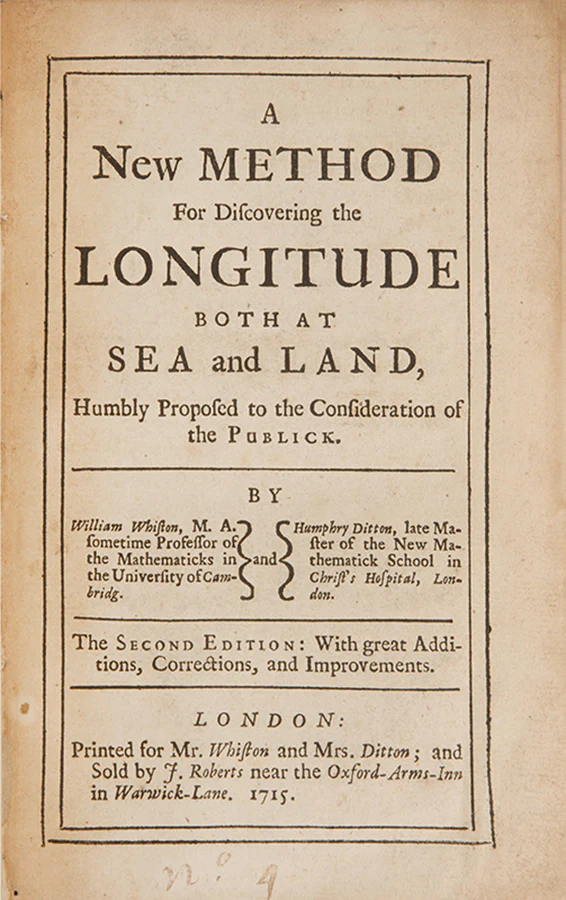
A New Method for Discovering the Longitude Both at Sea and land,
rare
Second edition of this early contribution to the longitude challenge by one of its proposers. Rare in all editions, with only three copies appearing in auction records since 1988, two of the first edition and one of the second.Theologian and mathematician William Whiston (1667-1752) was Lucasian professor at Cambridge, a friend of Newton, and one of his leading supporters. He also 'played an important role in early eighteenth-century attempts to determine longitude at sea... convinced that a reliable method would benefit both safety and trade. Whiston and Ditton petitioned parliament in 1714 suggesting a reward be offered for a method accurate to one degree at sea. After the intervention of Newton, Clarke, Cotes, and Edmond Halley (1656–1742), and the circulation of a broadsheet printed by Whiston and Ditton, the Longitude Act was passed the same year. The act and its reward triggered a plethora of hopeful solutions, with Whiston himself presenting several methods. The first of these was Whiston's and Ditton's New Method for Discovering the Longitude both at Sea and Land (1714), which proposed that ships anchored at precise intervals across the Atlantic fire star shells to 6440 feet at set times, thus allowing navigators to determine their longitude by calculating the time between the flash and sound of the shell' (Oxford Dictionary of National Biography).
Second edition; 8vo (18 x 11.5 cm); 3 copperplate engravings in the text, publisher's ads on the final leaf of text, small contemporary ink note to title, lacking the half title, two small wormholes, mainly in the lower margin but sometimes touching the text, contents a little toned and with occasional small spots and marks; bound to style in 20th-century half calf with marbled sides, spine gilt in compartments, red morocco label, red speckled edges, endpapers renewed, binding lightly rubbed and scuffed, a very good copy; 104pp.
ESTC T39883.
$265,333.27
A New Method for Discovering the Longitude Both at Sea and land,—
$265,333.27
Product Information
Product Information
Shipping & Returns
Shipping & Returns
Description
rare
Second edition of this early contribution to the longitude challenge by one of its proposers. Rare in all editions, with only three copies appearing in auction records since 1988, two of the first edition and one of the second.Theologian and mathematician William Whiston (1667-1752) was Lucasian professor at Cambridge, a friend of Newton, and one of his leading supporters. He also 'played an important role in early eighteenth-century attempts to determine longitude at sea... convinced that a reliable method would benefit both safety and trade. Whiston and Ditton petitioned parliament in 1714 suggesting a reward be offered for a method accurate to one degree at sea. After the intervention of Newton, Clarke, Cotes, and Edmond Halley (1656–1742), and the circulation of a broadsheet printed by Whiston and Ditton, the Longitude Act was passed the same year. The act and its reward triggered a plethora of hopeful solutions, with Whiston himself presenting several methods. The first of these was Whiston's and Ditton's New Method for Discovering the Longitude both at Sea and Land (1714), which proposed that ships anchored at precise intervals across the Atlantic fire star shells to 6440 feet at set times, thus allowing navigators to determine their longitude by calculating the time between the flash and sound of the shell' (Oxford Dictionary of National Biography).
Second edition; 8vo (18 x 11.5 cm); 3 copperplate engravings in the text, publisher's ads on the final leaf of text, small contemporary ink note to title, lacking the half title, two small wormholes, mainly in the lower margin but sometimes touching the text, contents a little toned and with occasional small spots and marks; bound to style in 20th-century half calf with marbled sides, spine gilt in compartments, red morocco label, red speckled edges, endpapers renewed, binding lightly rubbed and scuffed, a very good copy; 104pp.
ESTC T39883.