🚚 Free Worldwide Shipping on All Orders!Shop Now
1 / 2
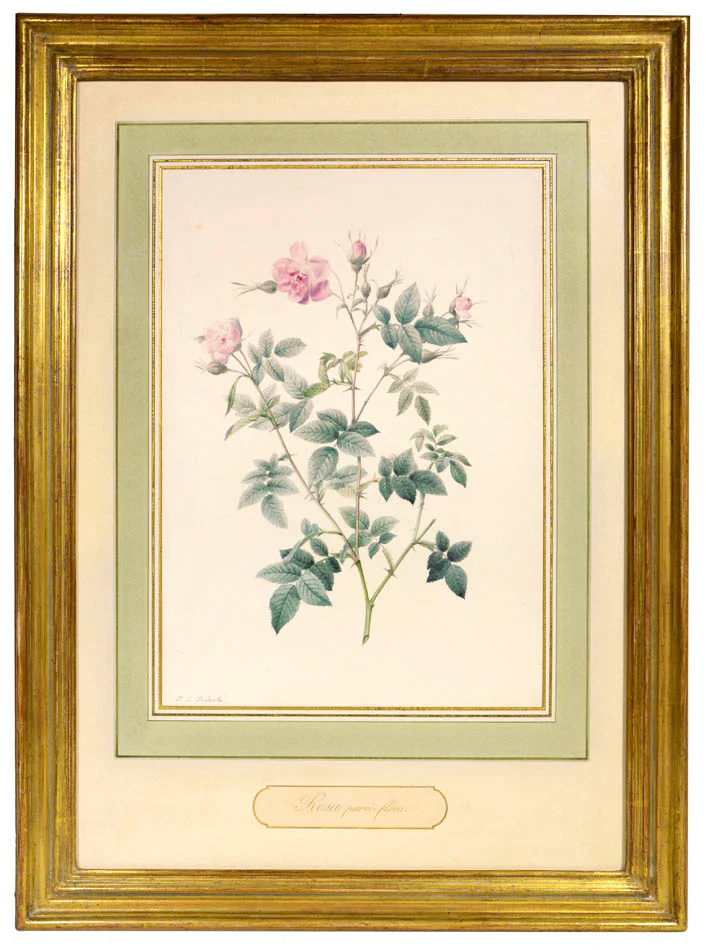
Rosa parvi-flora.
On original watercolour - given by King Charles X to the Duchesse de Berry. a beautiful example of the work of 'the Raphael of flowers', the most celebrated botanical artist of his day; with a fine princely provenance.
Redoute's patrons included two Empresses and two Queens, and his prodigious talents placed him at the centre of French court life, both before and after the Revolution. He was appointed drawing master to Marie Antoinette, yet despite his connections to the Royal family he survived the Terror and went on to become the court and flower painter to Empress Joséphine. It was because of her patronage that Redouté undertook Les Liliacées, which together with Les Roses, constitute the artist's greatest works. Although Joséphine had died three years before the publication of Les Roses, it was the unequalled collection of roses on her estate at Malmaison that provided the artist with his inspiration.
Exhibited:
Paris, Musée de la Vie Romantique, Jardins romantiques français, du jardins des Lumières au parc romantique 1770 - 1840, 2011, no. 78;
Haarlem, Teylers Museum, Redoute's Roses, 2013, pp. 135 and 161, under Les Roses.
Watercolour over traces of black chalk on vellum, within gold framing lines; signed in pen and brown ink, lower left: P. J. Redouté.; 385 x 270 mm. (15 1/4 x 10 5/8 in).
Redoute's patrons included two Empresses and two Queens, and his prodigious talents placed him at the centre of French court life, both before and after the Revolution. He was appointed drawing master to Marie Antoinette, yet despite his connections to the Royal family he survived the Terror and went on to become the court and flower painter to Empress Joséphine. It was because of her patronage that Redouté undertook Les Liliacées, which together with Les Roses, constitute the artist's greatest works. Although Joséphine had died three years before the publication of Les Roses, it was the unequalled collection of roses on her estate at Malmaison that provided the artist with his inspiration.
Exhibited:
Paris, Musée de la Vie Romantique, Jardins romantiques français, du jardins des Lumières au parc romantique 1770 - 1840, 2011, no. 78;
Haarlem, Teylers Museum, Redoute's Roses, 2013, pp. 135 and 161, under Les Roses.
Watercolour over traces of black chalk on vellum, within gold framing lines; signed in pen and brown ink, lower left: P. J. Redouté.; 385 x 270 mm. (15 1/4 x 10 5/8 in).
$20,101.01
Original: $67,003.35
-70%Rosa parvi-flora.—
$67,003.35
$20,101.01Product Information
Product Information
Shipping & Returns
Shipping & Returns
Description
On original watercolour - given by King Charles X to the Duchesse de Berry. a beautiful example of the work of 'the Raphael of flowers', the most celebrated botanical artist of his day; with a fine princely provenance.
Redoute's patrons included two Empresses and two Queens, and his prodigious talents placed him at the centre of French court life, both before and after the Revolution. He was appointed drawing master to Marie Antoinette, yet despite his connections to the Royal family he survived the Terror and went on to become the court and flower painter to Empress Joséphine. It was because of her patronage that Redouté undertook Les Liliacées, which together with Les Roses, constitute the artist's greatest works. Although Joséphine had died three years before the publication of Les Roses, it was the unequalled collection of roses on her estate at Malmaison that provided the artist with his inspiration.
Exhibited:
Paris, Musée de la Vie Romantique, Jardins romantiques français, du jardins des Lumières au parc romantique 1770 - 1840, 2011, no. 78;
Haarlem, Teylers Museum, Redoute's Roses, 2013, pp. 135 and 161, under Les Roses.
Watercolour over traces of black chalk on vellum, within gold framing lines; signed in pen and brown ink, lower left: P. J. Redouté.; 385 x 270 mm. (15 1/4 x 10 5/8 in).
Redoute's patrons included two Empresses and two Queens, and his prodigious talents placed him at the centre of French court life, both before and after the Revolution. He was appointed drawing master to Marie Antoinette, yet despite his connections to the Royal family he survived the Terror and went on to become the court and flower painter to Empress Joséphine. It was because of her patronage that Redouté undertook Les Liliacées, which together with Les Roses, constitute the artist's greatest works. Although Joséphine had died three years before the publication of Les Roses, it was the unequalled collection of roses on her estate at Malmaison that provided the artist with his inspiration.
Exhibited:
Paris, Musée de la Vie Romantique, Jardins romantiques français, du jardins des Lumières au parc romantique 1770 - 1840, 2011, no. 78;
Haarlem, Teylers Museum, Redoute's Roses, 2013, pp. 135 and 161, under Les Roses.
Watercolour over traces of black chalk on vellum, within gold framing lines; signed in pen and brown ink, lower left: P. J. Redouté.; 385 x 270 mm. (15 1/4 x 10 5/8 in).