🚚 Free Worldwide Shipping on All Orders!Shop Now
1 / 2
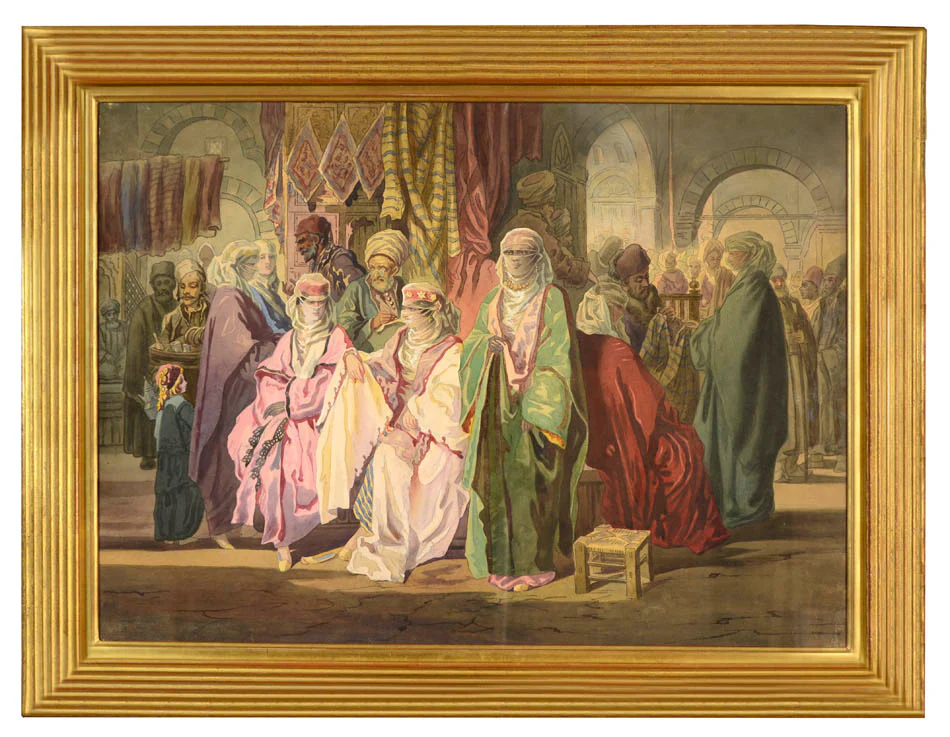
A pair of watercolours depicting scenes inside the Grand Bazaar at Istanbul.
A fine pair of views capturing the hubbub and activity of the Grand Bazaar.
The Grand Bazaar in Istanbul is one of the largest and oldest covered markets in the world, a network of 61 streets and thousands of shops.
The construction of the future Grand Bazaar's core started during the winter of 1455/56, shortly after the Ottoman conquest of Constantinople. Sultan Mehmet II had an edifice erected devoted to the trading of textiles. It was named Cevâhir Bedestan ('Bedesten of Gems'). The word bedesten means "bazaar of the cloth sellers" The building lies on the slope of the third hill of Istanbul, between the ancient Fora of Constantine and of Theodosius. It was also near the first sultan's palace, the Old Palace (Eski Sarayi), which was also in construction in those same years.
The present watercolours depict the Bazaar before the advent of shops as we know them, which were only introduced after the 1894 earthquake. Here we see traders sitting on wooden divans in front of their wares, with, in the foreground, prosperous visitors. In one, a merchant and his wife, in another a group of well-dressed, lightly veiled, Ottoman beauties.
A native of Malta, Preziosi first visited Istanbul in 1842, and depicting the city and its people in their distinctive costumes and attitudes was to be the focus of his artistic career thereafter. In the 1850s he worked for the Illustrated London News, and in 1866 Preziosi was invited to paint the official portrait of the Ottoman Sultan Abdülaziz for the Turkish Pavilion of the 1867 Universal Exhibition in Paris. During his time in Constantinople, which he made his home, Preziosi became the most popular painter in the city. In the age of the Grand Tour, and before the commercial development of photography, such works as this pair would be highly sought-after as mementoes of a visit to such an exotic land. Preziosi's gift for depicting people and costume, and free flowing lines, along with attention to small details, made his work particularly appealing. As copies of two of his original works, which are now housed in the Pera Museum in Istanbul, their visible age and the quality of their execution, place them firmly in the artist's studio or very close circle.
Watercolour with gouache over pencil and ink on buff paper, each 63 x 82 cm. (24 3/4 x 32 1/4 in), framed and glazed.
The Grand Bazaar in Istanbul is one of the largest and oldest covered markets in the world, a network of 61 streets and thousands of shops.
The construction of the future Grand Bazaar's core started during the winter of 1455/56, shortly after the Ottoman conquest of Constantinople. Sultan Mehmet II had an edifice erected devoted to the trading of textiles. It was named Cevâhir Bedestan ('Bedesten of Gems'). The word bedesten means "bazaar of the cloth sellers" The building lies on the slope of the third hill of Istanbul, between the ancient Fora of Constantine and of Theodosius. It was also near the first sultan's palace, the Old Palace (Eski Sarayi), which was also in construction in those same years.
The present watercolours depict the Bazaar before the advent of shops as we know them, which were only introduced after the 1894 earthquake. Here we see traders sitting on wooden divans in front of their wares, with, in the foreground, prosperous visitors. In one, a merchant and his wife, in another a group of well-dressed, lightly veiled, Ottoman beauties.
A native of Malta, Preziosi first visited Istanbul in 1842, and depicting the city and its people in their distinctive costumes and attitudes was to be the focus of his artistic career thereafter. In the 1850s he worked for the Illustrated London News, and in 1866 Preziosi was invited to paint the official portrait of the Ottoman Sultan Abdülaziz for the Turkish Pavilion of the 1867 Universal Exhibition in Paris. During his time in Constantinople, which he made his home, Preziosi became the most popular painter in the city. In the age of the Grand Tour, and before the commercial development of photography, such works as this pair would be highly sought-after as mementoes of a visit to such an exotic land. Preziosi's gift for depicting people and costume, and free flowing lines, along with attention to small details, made his work particularly appealing. As copies of two of his original works, which are now housed in the Pera Museum in Istanbul, their visible age and the quality of their execution, place them firmly in the artist's studio or very close circle.
Watercolour with gouache over pencil and ink on buff paper, each 63 x 82 cm. (24 3/4 x 32 1/4 in), framed and glazed.
$33,501.67
A pair of watercolours depicting scenes inside the Grand Bazaar at Istanbul.—
$33,501.67
Product Information
Product Information
Shipping & Returns
Shipping & Returns
Description
A fine pair of views capturing the hubbub and activity of the Grand Bazaar.
The Grand Bazaar in Istanbul is one of the largest and oldest covered markets in the world, a network of 61 streets and thousands of shops.
The construction of the future Grand Bazaar's core started during the winter of 1455/56, shortly after the Ottoman conquest of Constantinople. Sultan Mehmet II had an edifice erected devoted to the trading of textiles. It was named Cevâhir Bedestan ('Bedesten of Gems'). The word bedesten means "bazaar of the cloth sellers" The building lies on the slope of the third hill of Istanbul, between the ancient Fora of Constantine and of Theodosius. It was also near the first sultan's palace, the Old Palace (Eski Sarayi), which was also in construction in those same years.
The present watercolours depict the Bazaar before the advent of shops as we know them, which were only introduced after the 1894 earthquake. Here we see traders sitting on wooden divans in front of their wares, with, in the foreground, prosperous visitors. In one, a merchant and his wife, in another a group of well-dressed, lightly veiled, Ottoman beauties.
A native of Malta, Preziosi first visited Istanbul in 1842, and depicting the city and its people in their distinctive costumes and attitudes was to be the focus of his artistic career thereafter. In the 1850s he worked for the Illustrated London News, and in 1866 Preziosi was invited to paint the official portrait of the Ottoman Sultan Abdülaziz for the Turkish Pavilion of the 1867 Universal Exhibition in Paris. During his time in Constantinople, which he made his home, Preziosi became the most popular painter in the city. In the age of the Grand Tour, and before the commercial development of photography, such works as this pair would be highly sought-after as mementoes of a visit to such an exotic land. Preziosi's gift for depicting people and costume, and free flowing lines, along with attention to small details, made his work particularly appealing. As copies of two of his original works, which are now housed in the Pera Museum in Istanbul, their visible age and the quality of their execution, place them firmly in the artist's studio or very close circle.
Watercolour with gouache over pencil and ink on buff paper, each 63 x 82 cm. (24 3/4 x 32 1/4 in), framed and glazed.
The Grand Bazaar in Istanbul is one of the largest and oldest covered markets in the world, a network of 61 streets and thousands of shops.
The construction of the future Grand Bazaar's core started during the winter of 1455/56, shortly after the Ottoman conquest of Constantinople. Sultan Mehmet II had an edifice erected devoted to the trading of textiles. It was named Cevâhir Bedestan ('Bedesten of Gems'). The word bedesten means "bazaar of the cloth sellers" The building lies on the slope of the third hill of Istanbul, between the ancient Fora of Constantine and of Theodosius. It was also near the first sultan's palace, the Old Palace (Eski Sarayi), which was also in construction in those same years.
The present watercolours depict the Bazaar before the advent of shops as we know them, which were only introduced after the 1894 earthquake. Here we see traders sitting on wooden divans in front of their wares, with, in the foreground, prosperous visitors. In one, a merchant and his wife, in another a group of well-dressed, lightly veiled, Ottoman beauties.
A native of Malta, Preziosi first visited Istanbul in 1842, and depicting the city and its people in their distinctive costumes and attitudes was to be the focus of his artistic career thereafter. In the 1850s he worked for the Illustrated London News, and in 1866 Preziosi was invited to paint the official portrait of the Ottoman Sultan Abdülaziz for the Turkish Pavilion of the 1867 Universal Exhibition in Paris. During his time in Constantinople, which he made his home, Preziosi became the most popular painter in the city. In the age of the Grand Tour, and before the commercial development of photography, such works as this pair would be highly sought-after as mementoes of a visit to such an exotic land. Preziosi's gift for depicting people and costume, and free flowing lines, along with attention to small details, made his work particularly appealing. As copies of two of his original works, which are now housed in the Pera Museum in Istanbul, their visible age and the quality of their execution, place them firmly in the artist's studio or very close circle.
Watercolour with gouache over pencil and ink on buff paper, each 63 x 82 cm. (24 3/4 x 32 1/4 in), framed and glazed.