🚚 Free Worldwide Shipping on All Orders!Shop Now
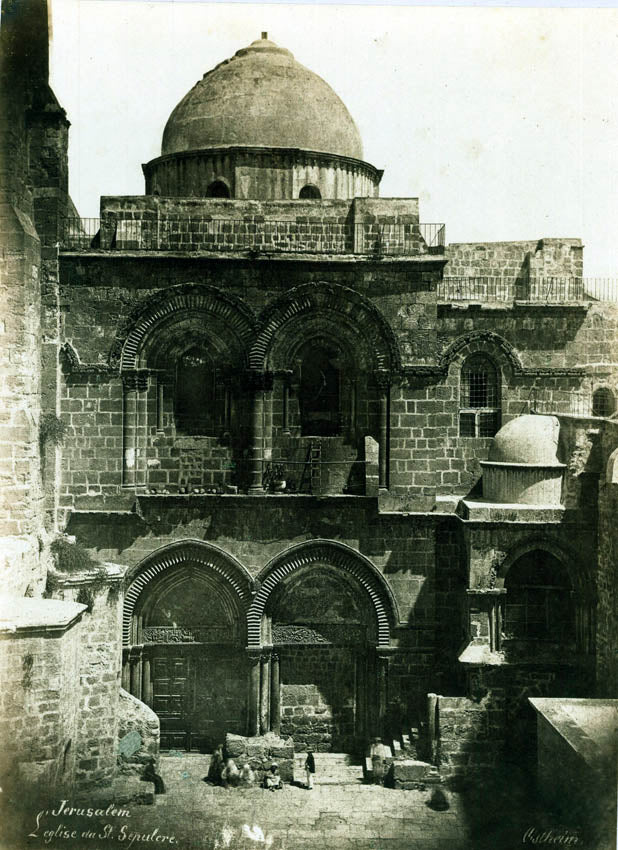
Church of the Holy Sepulchre, Jerusalem.
Othon Von Ostheim (aka Otto Von Ostheim) was an Austrian photographer, mainly active in the 1850-60s who is known for his few surviving photos of various famous sites in the Holy Land.
The Church of the Holy Sepulchre contains, according to traditions dating back to at least the fourth century, the two holiest sites in Christianity: the site where Jesus was crucified, and the tomb where he was buried and later resurrected. The photograph shows the front of the church and its main entrance, with the 'immovable ladder' which can be seen above the entrance, under the middle window. A few versions exist in relation to the original ownership and purpose of this ladder. It is known to be made of Lebanon cedar wood, was in its place by 1728 and has remained there ever since the 1757 Status Quo was established, aside from being temporarily moved twice. The ladder is referred to as immovable due to the agreement of the Status Quo among the religious communities sharing the religious sites in Jerusalem and Bethlehem that no cleric of the six ecumenical Christian orders may move, rearrange, or alter any property without the consent of the other five orders. The earliest record of the ladder is in a 1728 engraving by Elzearius Horn.
Albumen print from a paper negative. 255 x 350 mm. Very good tonal range and in good condition, photographer's title and credit in negative, pasted on original mount.
The Church of the Holy Sepulchre contains, according to traditions dating back to at least the fourth century, the two holiest sites in Christianity: the site where Jesus was crucified, and the tomb where he was buried and later resurrected. The photograph shows the front of the church and its main entrance, with the 'immovable ladder' which can be seen above the entrance, under the middle window. A few versions exist in relation to the original ownership and purpose of this ladder. It is known to be made of Lebanon cedar wood, was in its place by 1728 and has remained there ever since the 1757 Status Quo was established, aside from being temporarily moved twice. The ladder is referred to as immovable due to the agreement of the Status Quo among the religious communities sharing the religious sites in Jerusalem and Bethlehem that no cleric of the six ecumenical Christian orders may move, rearrange, or alter any property without the consent of the other five orders. The earliest record of the ladder is in a 1728 engraving by Elzearius Horn.
Albumen print from a paper negative. 255 x 350 mm. Very good tonal range and in good condition, photographer's title and credit in negative, pasted on original mount.
$417,028.85
Church of the Holy Sepulchre, Jerusalem.—
$417,028.85
Product Information
Product Information
Shipping & Returns
Shipping & Returns
Description
Othon Von Ostheim (aka Otto Von Ostheim) was an Austrian photographer, mainly active in the 1850-60s who is known for his few surviving photos of various famous sites in the Holy Land.
The Church of the Holy Sepulchre contains, according to traditions dating back to at least the fourth century, the two holiest sites in Christianity: the site where Jesus was crucified, and the tomb where he was buried and later resurrected. The photograph shows the front of the church and its main entrance, with the 'immovable ladder' which can be seen above the entrance, under the middle window. A few versions exist in relation to the original ownership and purpose of this ladder. It is known to be made of Lebanon cedar wood, was in its place by 1728 and has remained there ever since the 1757 Status Quo was established, aside from being temporarily moved twice. The ladder is referred to as immovable due to the agreement of the Status Quo among the religious communities sharing the religious sites in Jerusalem and Bethlehem that no cleric of the six ecumenical Christian orders may move, rearrange, or alter any property without the consent of the other five orders. The earliest record of the ladder is in a 1728 engraving by Elzearius Horn.
Albumen print from a paper negative. 255 x 350 mm. Very good tonal range and in good condition, photographer's title and credit in negative, pasted on original mount.
The Church of the Holy Sepulchre contains, according to traditions dating back to at least the fourth century, the two holiest sites in Christianity: the site where Jesus was crucified, and the tomb where he was buried and later resurrected. The photograph shows the front of the church and its main entrance, with the 'immovable ladder' which can be seen above the entrance, under the middle window. A few versions exist in relation to the original ownership and purpose of this ladder. It is known to be made of Lebanon cedar wood, was in its place by 1728 and has remained there ever since the 1757 Status Quo was established, aside from being temporarily moved twice. The ladder is referred to as immovable due to the agreement of the Status Quo among the religious communities sharing the religious sites in Jerusalem and Bethlehem that no cleric of the six ecumenical Christian orders may move, rearrange, or alter any property without the consent of the other five orders. The earliest record of the ladder is in a 1728 engraving by Elzearius Horn.
Albumen print from a paper negative. 255 x 350 mm. Very good tonal range and in good condition, photographer's title and credit in negative, pasted on original mount.