🚚 Free Worldwide Shipping on All Orders!Shop Now
1 / 7
Picturesque tour of the River Thames.
large paper copy
Fine set of classic Thames views. Large paper copy with superior colouring. Views include Eton (5 plates), Windsor (5 plates), Oxford (5 plates), Richmond (8 plates).Westall was an historical painter from a Norwich family, and is considered at his best in watercolour. The tour is presented in three sections: the first from the river's source to Oxford; the second from Oxford to London; and the third from London to where it joins the English Channel. Interestingly, at the time, it was felt necessary to offer some justification for the work appearing at all: the vogue when the present work was published was for picturesque scenery of the wilder and more exotic kind. The author in the Preface admits that whilst the Thames does not qualify as either wild or exotic, its banks do 'display all the softer graces and all the attractive loveliness of Nature in her sweetest mood, heightened by the taste, skill, and ingenuity of man; - they are decorated by venerable monuments of antiquity, and by prodigies of modern art.'
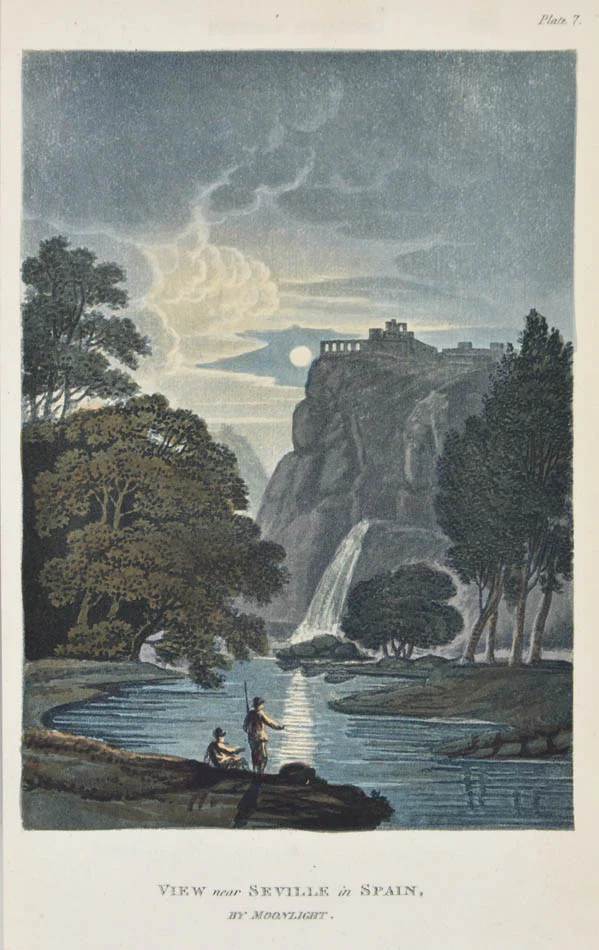
This book, along with Ireland's views and Boydell's work, helped establish a canon of most-favoured views of the Thames from the source to the sea. 'The colouring is less subdued than Boydell's, and there are more unaquatinted spaces where the interpretation has been left to the colour-washing artist. This gives the plates a greater resemblance to spontaneous water-colour drawings but leads inevitably to a greater disparity between individual copies.' (Adams)
First edition, 4to (41 x 33 cm), large paper copy, early issue with pre-publication watermarks (text 1820, plates 1827), folding map, 24 handcoloured aquatint plates, 2 hand coloured vignettes, by R.G. Reeve (13), C. Bentley (5), J. Bailey and J. Fielding, after Westall (19) and Owen; usual light offsetting to plates, green half morocco gilt extra, with the ink stains to plate of Twickenham as usual, later tissue guards, a fine example.
Abbey (Scenery), 435; Adams (London Illustrated), 157; Tooley p265.
$2,010.10
Original: $6,700.33
-70%Picturesque tour of the River Thames.—
$6,700.33
$2,010.10Product Information
Product Information
Shipping & Returns
Shipping & Returns
Description
large paper copy
Fine set of classic Thames views. Large paper copy with superior colouring. Views include Eton (5 plates), Windsor (5 plates), Oxford (5 plates), Richmond (8 plates).Westall was an historical painter from a Norwich family, and is considered at his best in watercolour. The tour is presented in three sections: the first from the river's source to Oxford; the second from Oxford to London; and the third from London to where it joins the English Channel. Interestingly, at the time, it was felt necessary to offer some justification for the work appearing at all: the vogue when the present work was published was for picturesque scenery of the wilder and more exotic kind. The author in the Preface admits that whilst the Thames does not qualify as either wild or exotic, its banks do 'display all the softer graces and all the attractive loveliness of Nature in her sweetest mood, heightened by the taste, skill, and ingenuity of man; - they are decorated by venerable monuments of antiquity, and by prodigies of modern art.'
This book, along with Ireland's views and Boydell's work, helped establish a canon of most-favoured views of the Thames from the source to the sea. 'The colouring is less subdued than Boydell's, and there are more unaquatinted spaces where the interpretation has been left to the colour-washing artist. This gives the plates a greater resemblance to spontaneous water-colour drawings but leads inevitably to a greater disparity between individual copies.' (Adams)
First edition, 4to (41 x 33 cm), large paper copy, early issue with pre-publication watermarks (text 1820, plates 1827), folding map, 24 handcoloured aquatint plates, 2 hand coloured vignettes, by R.G. Reeve (13), C. Bentley (5), J. Bailey and J. Fielding, after Westall (19) and Owen; usual light offsetting to plates, green half morocco gilt extra, with the ink stains to plate of Twickenham as usual, later tissue guards, a fine example.
Abbey (Scenery), 435; Adams (London Illustrated), 157; Tooley p265.