🚚 Free Worldwide Shipping on All Orders!Shop Now
1 / 4
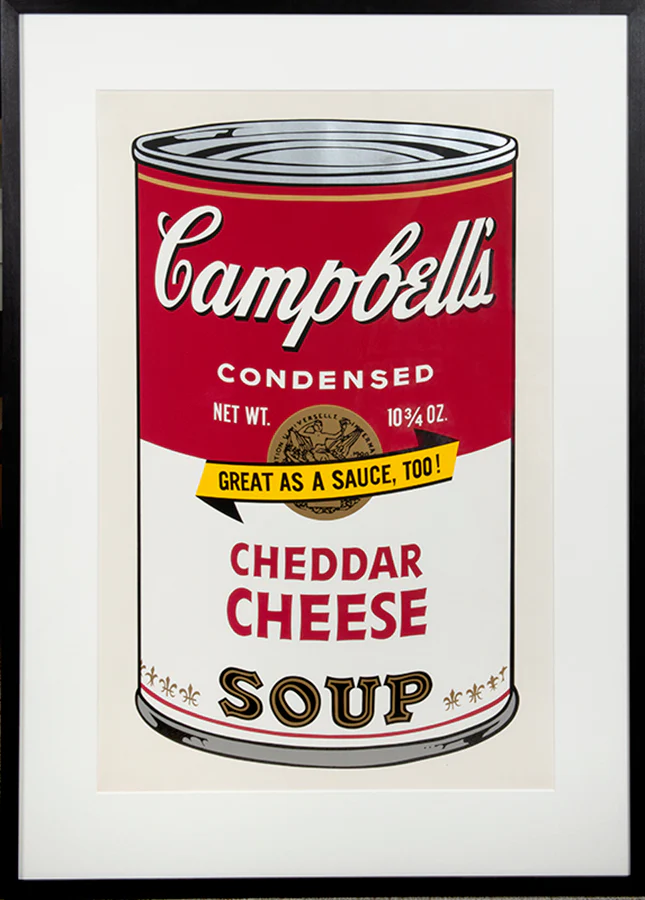
Cheddar Cheese, from Campbell's Soup II
The 'Campbell's' series is one of Andy Warhol's best-known icons. The original 32 canvases, each depicting a different Campbell's soup variety, were painted in 1962 after a friend's suggestion to paint something that everybody recognised. When the canvases were first exhibited at Fergus Gallery in Los Angeles, the reception was mostly of indifference or disdain. However, the collective power of the paintings was immediate and the gallerist Irving Blum immediately bought back the five paintings that he'd sold upon realising they functioned best as a group. Warhol went on to reinterpret these paintings as screenprints in 1968-69 to better achieve the meticulously finished, manufactured appearance. This technique also finalised his desire to remove all traces of the artist's hand from the artwork.
Screenprint in colours, 1969, on wove paper, signed in ball-point pen and numbered with a rubber stamp, verso, from the edition of 250 (there were also 26 artist's proofs lettered A-Z), printed by Salvatore Silkscreen Co., Inc., New York, published by Factory Additions, New York, 88.9 x 58.4 cm. (35 x 23 in.)
Feldman and Schellmann II.63
Screenprint in colours, 1969, on wove paper, signed in ball-point pen and numbered with a rubber stamp, verso, from the edition of 250 (there were also 26 artist's proofs lettered A-Z), printed by Salvatore Silkscreen Co., Inc., New York, published by Factory Additions, New York, 88.9 x 58.4 cm. (35 x 23 in.)
Feldman and Schellmann II.63
$87,104.35
Cheddar Cheese, from Campbell's Soup II—
$87,104.35
Product Information
Product Information
Shipping & Returns
Shipping & Returns
Description
The 'Campbell's' series is one of Andy Warhol's best-known icons. The original 32 canvases, each depicting a different Campbell's soup variety, were painted in 1962 after a friend's suggestion to paint something that everybody recognised. When the canvases were first exhibited at Fergus Gallery in Los Angeles, the reception was mostly of indifference or disdain. However, the collective power of the paintings was immediate and the gallerist Irving Blum immediately bought back the five paintings that he'd sold upon realising they functioned best as a group. Warhol went on to reinterpret these paintings as screenprints in 1968-69 to better achieve the meticulously finished, manufactured appearance. This technique also finalised his desire to remove all traces of the artist's hand from the artwork.
Screenprint in colours, 1969, on wove paper, signed in ball-point pen and numbered with a rubber stamp, verso, from the edition of 250 (there were also 26 artist's proofs lettered A-Z), printed by Salvatore Silkscreen Co., Inc., New York, published by Factory Additions, New York, 88.9 x 58.4 cm. (35 x 23 in.)
Feldman and Schellmann II.63
Screenprint in colours, 1969, on wove paper, signed in ball-point pen and numbered with a rubber stamp, verso, from the edition of 250 (there were also 26 artist's proofs lettered A-Z), printed by Salvatore Silkscreen Co., Inc., New York, published by Factory Additions, New York, 88.9 x 58.4 cm. (35 x 23 in.)
Feldman and Schellmann II.63