🚚 Free Worldwide Shipping on All Orders!Shop Now
1 / 6
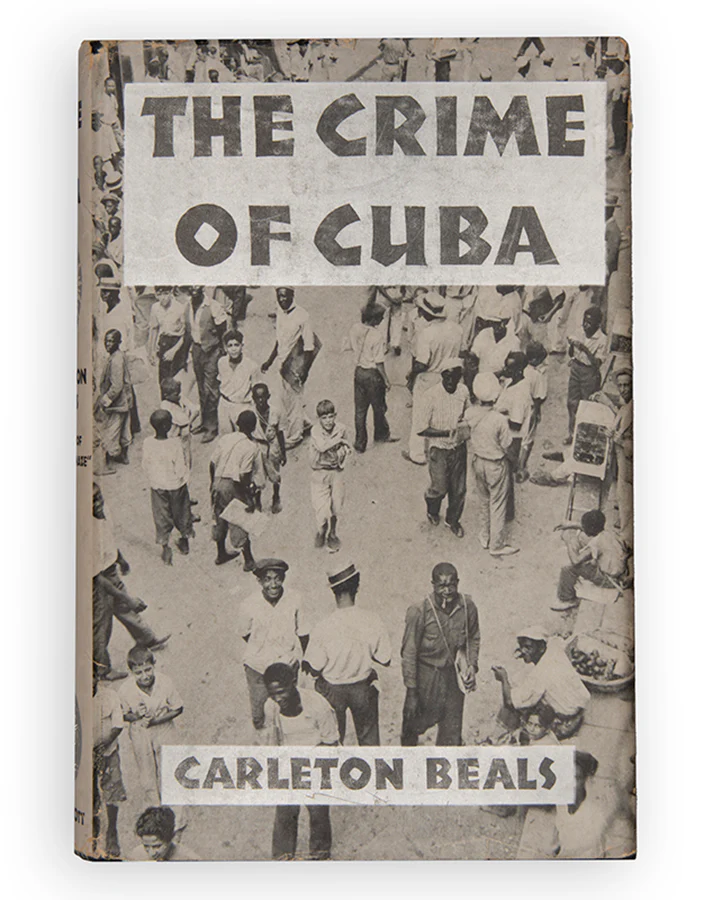
The Crime of Cuba.
These photographs represent the only period Walker Evans spent working as a photographer outside the United States. Carleton Beals wrote The Crime of Cuba out of anger for the political situation in Cuba and disapproval of the way America managed its relations with Latin American countries. He originally wanted his book to be illustrated with news photographs of demonstrations and violence on the streets of Cuba. Literary agent Ernestine Evans (no relation) suggested to Lippincott's art department that instead, they send Walker Evans to Havana, and they agreed.
Few of Evans's photographs could be said to show the oppression or poverty Beals writes about; Evans later claimed not to have read the book, apparently treating the project as an entirely commercial venture. However, he himself selected and sequenced the final thirty-one photographs, inserting a few pictures from news agencies to supplement the photography section, a signal of Evans's growing interest in anonymous imagery; he was a regular visitor, with Ben Shahn, to the New York Public Library's picture collection.
First edition; 8vo (218 x 145 mm, 8½ x 5¾ in); black-and-white photographs printed in aquatone, red topstain; red endpapers, black cloth-covered boards, spine and upper board stamped in silver, head bumped, photo-illustrated price-clipped dust-jacket, silver and black, light wear to extremities, lightly soiled, nicked with small chips and light creasing to head and edges, Gas Company leaflet laid in, near-fine in a very good dust-jacket; [ii], 441, [1], [64]pp.
Regards à travers Le Livre 57; Auer Collection p205.
Few of Evans's photographs could be said to show the oppression or poverty Beals writes about; Evans later claimed not to have read the book, apparently treating the project as an entirely commercial venture. However, he himself selected and sequenced the final thirty-one photographs, inserting a few pictures from news agencies to supplement the photography section, a signal of Evans's growing interest in anonymous imagery; he was a regular visitor, with Ben Shahn, to the New York Public Library's picture collection.
First edition; 8vo (218 x 145 mm, 8½ x 5¾ in); black-and-white photographs printed in aquatone, red topstain; red endpapers, black cloth-covered boards, spine and upper board stamped in silver, head bumped, photo-illustrated price-clipped dust-jacket, silver and black, light wear to extremities, lightly soiled, nicked with small chips and light creasing to head and edges, Gas Company leaflet laid in, near-fine in a very good dust-jacket; [ii], 441, [1], [64]pp.
Regards à travers Le Livre 57; Auer Collection p205.
$355.77
Original: $1,185.89
-70%The Crime of Cuba.—
$1,185.89
$355.77Product Information
Product Information
Shipping & Returns
Shipping & Returns
Description
These photographs represent the only period Walker Evans spent working as a photographer outside the United States. Carleton Beals wrote The Crime of Cuba out of anger for the political situation in Cuba and disapproval of the way America managed its relations with Latin American countries. He originally wanted his book to be illustrated with news photographs of demonstrations and violence on the streets of Cuba. Literary agent Ernestine Evans (no relation) suggested to Lippincott's art department that instead, they send Walker Evans to Havana, and they agreed.
Few of Evans's photographs could be said to show the oppression or poverty Beals writes about; Evans later claimed not to have read the book, apparently treating the project as an entirely commercial venture. However, he himself selected and sequenced the final thirty-one photographs, inserting a few pictures from news agencies to supplement the photography section, a signal of Evans's growing interest in anonymous imagery; he was a regular visitor, with Ben Shahn, to the New York Public Library's picture collection.
First edition; 8vo (218 x 145 mm, 8½ x 5¾ in); black-and-white photographs printed in aquatone, red topstain; red endpapers, black cloth-covered boards, spine and upper board stamped in silver, head bumped, photo-illustrated price-clipped dust-jacket, silver and black, light wear to extremities, lightly soiled, nicked with small chips and light creasing to head and edges, Gas Company leaflet laid in, near-fine in a very good dust-jacket; [ii], 441, [1], [64]pp.
Regards à travers Le Livre 57; Auer Collection p205.
Few of Evans's photographs could be said to show the oppression or poverty Beals writes about; Evans later claimed not to have read the book, apparently treating the project as an entirely commercial venture. However, he himself selected and sequenced the final thirty-one photographs, inserting a few pictures from news agencies to supplement the photography section, a signal of Evans's growing interest in anonymous imagery; he was a regular visitor, with Ben Shahn, to the New York Public Library's picture collection.
First edition; 8vo (218 x 145 mm, 8½ x 5¾ in); black-and-white photographs printed in aquatone, red topstain; red endpapers, black cloth-covered boards, spine and upper board stamped in silver, head bumped, photo-illustrated price-clipped dust-jacket, silver and black, light wear to extremities, lightly soiled, nicked with small chips and light creasing to head and edges, Gas Company leaflet laid in, near-fine in a very good dust-jacket; [ii], 441, [1], [64]pp.
Regards à travers Le Livre 57; Auer Collection p205.