🚚 Free Worldwide Shipping on All Orders!Shop Now
1 / 3
The Prevention of Malaria.
preventing malaria by understanding its transmission
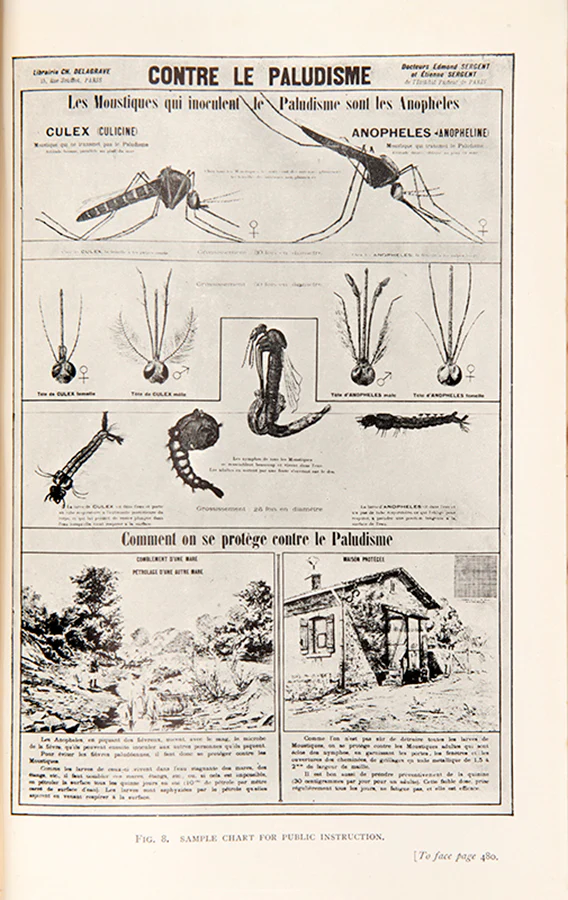
First edition of this comprehensive work on the epidemiology of malaria by the doctor who identified the pathogen's transmission route, with important statistical analysis of mosquito control as a preventive measure.Ronald Ross (1857-1932) was a physician in the Indian Medical Service who became interested in malaria during the 1890s. He was mentored by Patrick Manson, the leading British specialist in tropical diseases, and set out to prove Manson's mosquito hypothesis. Ross's first breakthrough was proving that the parasite could be transmitted to mosquito stomachs from infected humans, and he was then able to track the entire infection cycle in birds using avian malaria. It was the Italian Giovanni Battista Grassi who conclusively demonstrated the cycle in humans shortly thereafter.
During the resulting debates on prevention, Ross 'strongly favoured vector control as the most cost-efficient means to prevent the disease, and he developed a sophisticated mathematical model of malaria epidemiology to show that it was not necessary to eradicate all Anophelines in a particular area to effect a significant reduction in malaria incidence. Ross's model was rooted in the mathematics of probability (what he called a theory of happenings), and although it was later recognized as a basis of mathematical epidemiology it was poorly appreciated in Ross's lifetime and made relatively little impact' (Oxford Dictionary of National Biography). Ross elaborated on his mathematical ideas in The Prevention of Malaria, which contained 'chapters by different experts on malaria control in many malarious countries, but the bulk of the monograph contained Ross's own reconstruction of the contributions made by various individuals to the discovery of the transmission of malaria by Anopheles mosquitoes' (ODNB). It also includes sections on the history of malaria and the progress and symptoms of the disease.
First edition, first impression; 8vo; 30 plates of which 3 are folding, tables and graphs within the text, 4 leaves of ads at rear, ink stamps of the John Holt Company to the front free endpaper and pages 95, 241, 273, 289, and 481 as well as two of the folding plates; original red cloth, titles to spine and upper board gilt, borders blocked in blind, cloth a little rubbed at the extremities, spotting to edges of the text block and early and late leaves, scattered spotting to the contents, very good condition; 669pp.
$201.01
Original: $670.03
-70%The Prevention of Malaria.—
$670.03
$201.01Product Information
Product Information
Shipping & Returns
Shipping & Returns
Description
preventing malaria by understanding its transmission
First edition of this comprehensive work on the epidemiology of malaria by the doctor who identified the pathogen's transmission route, with important statistical analysis of mosquito control as a preventive measure.Ronald Ross (1857-1932) was a physician in the Indian Medical Service who became interested in malaria during the 1890s. He was mentored by Patrick Manson, the leading British specialist in tropical diseases, and set out to prove Manson's mosquito hypothesis. Ross's first breakthrough was proving that the parasite could be transmitted to mosquito stomachs from infected humans, and he was then able to track the entire infection cycle in birds using avian malaria. It was the Italian Giovanni Battista Grassi who conclusively demonstrated the cycle in humans shortly thereafter.
During the resulting debates on prevention, Ross 'strongly favoured vector control as the most cost-efficient means to prevent the disease, and he developed a sophisticated mathematical model of malaria epidemiology to show that it was not necessary to eradicate all Anophelines in a particular area to effect a significant reduction in malaria incidence. Ross's model was rooted in the mathematics of probability (what he called a theory of happenings), and although it was later recognized as a basis of mathematical epidemiology it was poorly appreciated in Ross's lifetime and made relatively little impact' (Oxford Dictionary of National Biography). Ross elaborated on his mathematical ideas in The Prevention of Malaria, which contained 'chapters by different experts on malaria control in many malarious countries, but the bulk of the monograph contained Ross's own reconstruction of the contributions made by various individuals to the discovery of the transmission of malaria by Anopheles mosquitoes' (ODNB). It also includes sections on the history of malaria and the progress and symptoms of the disease.
First edition, first impression; 8vo; 30 plates of which 3 are folding, tables and graphs within the text, 4 leaves of ads at rear, ink stamps of the John Holt Company to the front free endpaper and pages 95, 241, 273, 289, and 481 as well as two of the folding plates; original red cloth, titles to spine and upper board gilt, borders blocked in blind, cloth a little rubbed at the extremities, spotting to edges of the text block and early and late leaves, scattered spotting to the contents, very good condition; 669pp.