🚚 Free Worldwide Shipping on All Orders!Shop Now
1 / 10
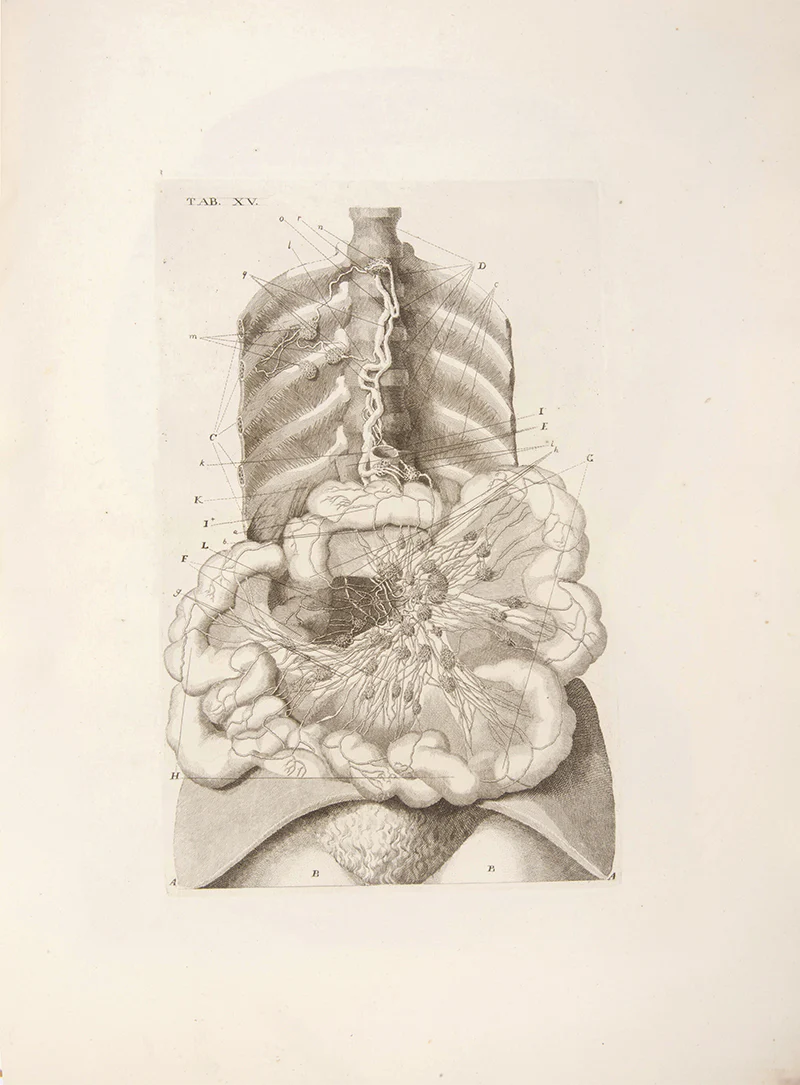
Vasorum Lymphaticorum Corporis Humani Historia et Ichnographia.
extraordinarily fine detail
First edition of this groundbreaking atlas of the lymphatic system.'Mascagni discovered half the lymphatic vessels now known. Using the mercury injection method (which he perfected) and a tubular needle bent at a right angle, he observed, named and described almost all the lymph glands and vessels in the human body, concluding that the lymphatic system originates from all internal and external cavities and surfaces of the body, and that it is related to the absorbing function. He demonstrated the connection between the lymphs and serous vessels, and disproved Boerhaave's theory of arterial and venous lymphatics by showing that they did not exist. The spectacular copperplates by Ciro Santi in this work depict vessels in some of the finest detail present in anatomical illustrations before the advent of photography' (Hook & Norman, The Norman Library of Science and Medicine 1450).
First edition; double folio (57 x 43 cm); 41 engraved plates, wide-margined, some spotting to contents, minor dampstain in the lower corner; early 19th century quarter vellum, drab paste paper boards, morocco label to spine, edges speckled blue, old repairs to corners, a little wear and some markings to the binding, very good condition; 138pp.
Garrison & Morton, A Medical Bibliography 1104; Hook & Norman, The Norman Library of Science and Medicine 1450; Heirs of Hippocrates 1099; Choulant pp.315-316.
$3,015.15
Original: $10,050.50
-70%Vasorum Lymphaticorum Corporis Humani Historia et Ichnographia.—
$10,050.50
$3,015.15Product Information
Product Information
Shipping & Returns
Shipping & Returns
Description
extraordinarily fine detail
First edition of this groundbreaking atlas of the lymphatic system.'Mascagni discovered half the lymphatic vessels now known. Using the mercury injection method (which he perfected) and a tubular needle bent at a right angle, he observed, named and described almost all the lymph glands and vessels in the human body, concluding that the lymphatic system originates from all internal and external cavities and surfaces of the body, and that it is related to the absorbing function. He demonstrated the connection between the lymphs and serous vessels, and disproved Boerhaave's theory of arterial and venous lymphatics by showing that they did not exist. The spectacular copperplates by Ciro Santi in this work depict vessels in some of the finest detail present in anatomical illustrations before the advent of photography' (Hook & Norman, The Norman Library of Science and Medicine 1450).
First edition; double folio (57 x 43 cm); 41 engraved plates, wide-margined, some spotting to contents, minor dampstain in the lower corner; early 19th century quarter vellum, drab paste paper boards, morocco label to spine, edges speckled blue, old repairs to corners, a little wear and some markings to the binding, very good condition; 138pp.
Garrison & Morton, A Medical Bibliography 1104; Hook & Norman, The Norman Library of Science and Medicine 1450; Heirs of Hippocrates 1099; Choulant pp.315-316.