🚚 Free Worldwide Shipping on All Orders!Shop Now
1 / 2
Journal of the discovery of the source of the Nile.
Speke's third and final expedition to Africa
The account of Speke's third and final expedition to Africa. This took place in 1860 with his friend and fellow Indian army officer James Grant (1827-1892) on an expedition organized by the Royal Geographic Society and supported by the British government. Their purpose was to explore the Victoria Nyanza area and confirm Speke's earlier view that the lake was the source of the White Nile.Back in England, Speke was showered with honours and feted by the Royal Geographical Society. But doubts of his claim remained, voiced particularly by Burton, primarily because Speke had not followed the Nile from Karuma Falls to Gondokoro. (Using Speke's maps, Baker would discover what Speke had thereby missed: Lake Albert.) A debate with his former friend-turned-nemesis Burton was arranged for 16 September 1864 to settle the matter; however, on that morning word arrived that Speke had died in a gun accident. Some thought it was a suicide, for he was known as an accomplished sportsman and hunter. Speke and Grant's successes are undisputed, however: they were the first Europeans to cross equatorial eastern Africa, and their explorations added more than 500 miles to the known geography of the area. Today Lake Victoria and its feeder streams are considered the sources of the White Nile.
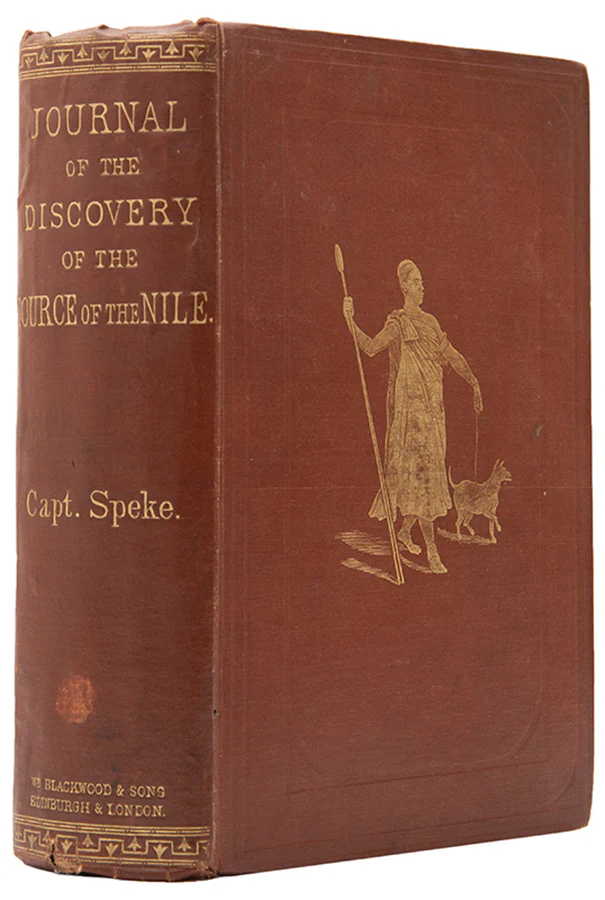
First edition, 8vo, xxxi, [1], 658 pp., 32 pages ads at end (one dated April June 1863), engraved frontispiece portrait of Speke, engraved portrait of Grant, 24 engraved plates, 2 maps (1 folding), illustrations in text, original brown cloth gilt, gilt pictorial vignette to upper cover, light wear, a very good copy.
Hilmy II, p255.
$3,015.15
Journal of the discovery of the source of the Nile.—
$3,015.15
Product Information
Product Information
Shipping & Returns
Shipping & Returns
Description
Speke's third and final expedition to Africa
The account of Speke's third and final expedition to Africa. This took place in 1860 with his friend and fellow Indian army officer James Grant (1827-1892) on an expedition organized by the Royal Geographic Society and supported by the British government. Their purpose was to explore the Victoria Nyanza area and confirm Speke's earlier view that the lake was the source of the White Nile.Back in England, Speke was showered with honours and feted by the Royal Geographical Society. But doubts of his claim remained, voiced particularly by Burton, primarily because Speke had not followed the Nile from Karuma Falls to Gondokoro. (Using Speke's maps, Baker would discover what Speke had thereby missed: Lake Albert.) A debate with his former friend-turned-nemesis Burton was arranged for 16 September 1864 to settle the matter; however, on that morning word arrived that Speke had died in a gun accident. Some thought it was a suicide, for he was known as an accomplished sportsman and hunter. Speke and Grant's successes are undisputed, however: they were the first Europeans to cross equatorial eastern Africa, and their explorations added more than 500 miles to the known geography of the area. Today Lake Victoria and its feeder streams are considered the sources of the White Nile.
First edition, 8vo, xxxi, [1], 658 pp., 32 pages ads at end (one dated April June 1863), engraved frontispiece portrait of Speke, engraved portrait of Grant, 24 engraved plates, 2 maps (1 folding), illustrations in text, original brown cloth gilt, gilt pictorial vignette to upper cover, light wear, a very good copy.
Hilmy II, p255.