🚚 Free Worldwide Shipping on All Orders!Shop Now
1 / 9
A Short Account of London-Bridge;
copy of renowned waterway architect
Two scarce works that proposed the Westminster Bridge, owned by a renowned waterway architect. The plates for these works are scarcer still, and rarely in such good condition.As early as 1664 there had been calls for a bridge in London further west than London Bridge, but it was not until a temporary wooden bridge was built at Putney that public opinion swayed in support. Nicholas Hawksmoor (c.1661-1736), one of the great architects of London following the Great Fire, proposed Westminster Bridge with this first work and Parliament approved the project the same year. Nicholas Lediard (1685–1743) took up the mantle of the project and made further suggestions including this second work on building the connecting roads to the bridge. He was appointed Agent and Surveyor of Westminster Bridge during its commencement in 1739 but he would die before seeing it completed.
Most of the Hawksmoor copies only have five (or fewer plates). The sixth plate in this copy is a second or different state of 'The Section of ye Thames' plate (also present) which shows the same content but adds a diagram of a proposal to create a stopgap measure of just building the pillars in stone and the rest of the bridge in timber (starts 'A Proposal for Building ye Bridge with Peers of Stone...'), and is not the plate six in the 2nd Bromhead copy titled 'Plan of the ground floor of a charter school house...'.
Robert Mylne (1733–1811) studied as a carpenter and mason before becoming an architect. Spurred on by Piranesi encouraging his interest in waterway architecture, he submitted the winning design of Blackfriars Bridge and would be appointed surveyor and overseer of the construction. He would go on to be surveyor of the New River Co., overseeing construction of the Gloucester and Berkeley Canal and the Eau Brink Cut. His son, William Chadwell Mylne (1781-1863), would continue in his stead and had a prolific 50 year career as Surveyor to the Stationers' Company specialising in water-work architecture.
The Hawksmoor is commercially scarce. Lediard only in 5 UK institutions (BL, Wellcome, Oxford, Edinburgh, St Andrews).
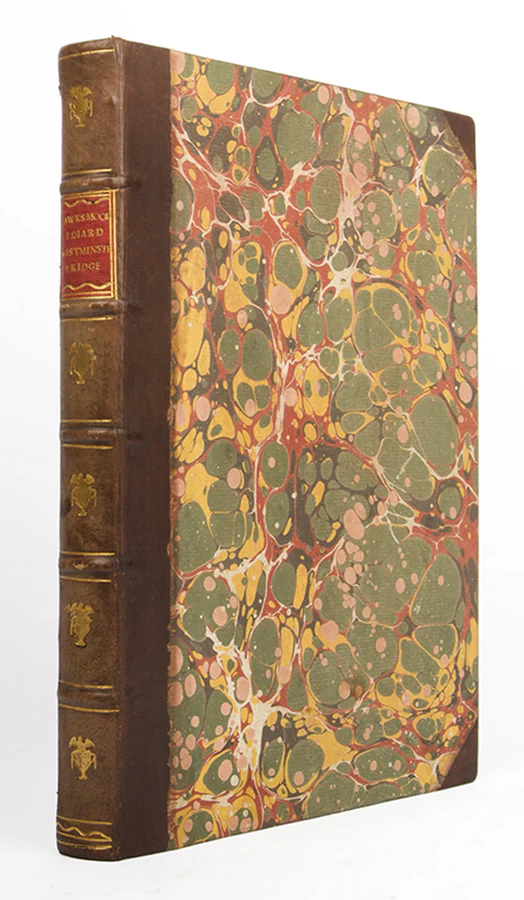
First editions; 2 works in 1 vol., small 4to (25.5 x 20 cm); [Hawksmoor] 6 folding plates, some with minor tears to hinges or folds repaired, fore-edges a little frayed, armorial bookplate to restored blank and ownership inscription to second blank, occasional discreet marginal pencil annotations, small paper repair to title; 47, [1] pp.; [Lediard] 3 folding plates, some minor fraying to margins, small tear to hinge of large plan repaired, discreet pencil annotation to margins and plan; 26 pp; later half calf, marbled boards, spine in six gilt compartments, gilt morocco lettering piece,
Cohen, p.36, 47; Harris 326, 487.
$189,918,315.44
A Short Account of London-Bridge;—
$189,918,315.44
Product Information
Product Information
Shipping & Returns
Shipping & Returns
Description
copy of renowned waterway architect
Two scarce works that proposed the Westminster Bridge, owned by a renowned waterway architect. The plates for these works are scarcer still, and rarely in such good condition.As early as 1664 there had been calls for a bridge in London further west than London Bridge, but it was not until a temporary wooden bridge was built at Putney that public opinion swayed in support. Nicholas Hawksmoor (c.1661-1736), one of the great architects of London following the Great Fire, proposed Westminster Bridge with this first work and Parliament approved the project the same year. Nicholas Lediard (1685–1743) took up the mantle of the project and made further suggestions including this second work on building the connecting roads to the bridge. He was appointed Agent and Surveyor of Westminster Bridge during its commencement in 1739 but he would die before seeing it completed.
Most of the Hawksmoor copies only have five (or fewer plates). The sixth plate in this copy is a second or different state of 'The Section of ye Thames' plate (also present) which shows the same content but adds a diagram of a proposal to create a stopgap measure of just building the pillars in stone and the rest of the bridge in timber (starts 'A Proposal for Building ye Bridge with Peers of Stone...'), and is not the plate six in the 2nd Bromhead copy titled 'Plan of the ground floor of a charter school house...'.
Robert Mylne (1733–1811) studied as a carpenter and mason before becoming an architect. Spurred on by Piranesi encouraging his interest in waterway architecture, he submitted the winning design of Blackfriars Bridge and would be appointed surveyor and overseer of the construction. He would go on to be surveyor of the New River Co., overseeing construction of the Gloucester and Berkeley Canal and the Eau Brink Cut. His son, William Chadwell Mylne (1781-1863), would continue in his stead and had a prolific 50 year career as Surveyor to the Stationers' Company specialising in water-work architecture.
The Hawksmoor is commercially scarce. Lediard only in 5 UK institutions (BL, Wellcome, Oxford, Edinburgh, St Andrews).
First editions; 2 works in 1 vol., small 4to (25.5 x 20 cm); [Hawksmoor] 6 folding plates, some with minor tears to hinges or folds repaired, fore-edges a little frayed, armorial bookplate to restored blank and ownership inscription to second blank, occasional discreet marginal pencil annotations, small paper repair to title; 47, [1] pp.; [Lediard] 3 folding plates, some minor fraying to margins, small tear to hinge of large plan repaired, discreet pencil annotation to margins and plan; 26 pp; later half calf, marbled boards, spine in six gilt compartments, gilt morocco lettering piece,
Cohen, p.36, 47; Harris 326, 487.