🚚 Free Worldwide Shipping on All Orders!Shop Now
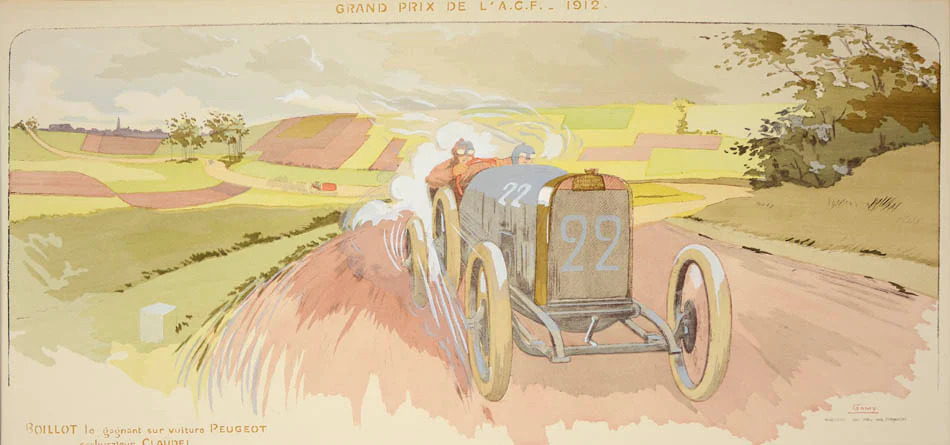
GRAND PRIX DE L' A.C.F. - 1912.
The symbiotic relationship between prestigious motor sports and technological advances in engineering, with the concomitant potential for mutual publicity, which are so familiar today, clearly date back to these formative years. Georges Boillot (1884-1916) is depicted taking the lead the French Grand Prix in Dieppe, in 1912, which he went on to win. He was driving the legendary Peugeot L76, powered by the first motor ever to to have double overhead camshafts and 4 valves per cylinder, still seen recognised as key elements of higher performing engines today.
Boillot was in the same team as Jules Goux, who is depicted winning the Indianapolis 500, in 1913, in another print in this Gamy-Montaut series. It was during that race in 1914, that Boillot came within a whisker of breaking the 100mph barrier, recording a speed of 99.86mph. He was to retire after the next French Grand Prix later that year. He saw service during WW1, first using his driving skills to take the commander-in-chief, General Joffre, at high speed to meetings along the front, before seeking more excitement as a pilot. He bacame a flying ace, winning the Croix de Guerre and Legion d'Honneur, before being shot down and killed in 1916.
Ernest Montaut (1878-1909) was an innovative French poster designer whose all-too-short career captured the exhilarating new world of motorised transport, whether in the air, on the water, or especially at high speed on the ground. He introduced the stylistic conceits of close horizontal lines and forward-leaning perspective in his vehicles, for instance, to exaggerate the sense of rapid motion. This period from the mid-1890s saw not only the rapid evolution of the motor car, but also the application of the internal combustion engine to boat design, as well as being fundamental in making possible the whole new concept of powered flight.
Montaut was joined in this endeavour by his wife, Marguerite (1883-1936), who expanding the range of earlier motoring posters to include aviation. She occasionally signed herself as M. Montaut, but more often as Gamy, an anagram of her familiar name, Magy. Following her husband's untimely death at the age of only 31, Marguerite continued their good work in the same distinctive and highly appealing style. This centred on the bold flat colours of the pochoir printing technique they mastered so well. Outlines and any text were printed lithographically, then corresponding stencils carefully prepared to allow in-filling by hand in watercolour and gouache, employing a number of artists for the purpose, leading to subtle variations in colour in each painstaking example, often taking days to complete. It is this combination of factors that gives these highly attractive prints their superlative quality.
Hand-coloured pochoir print, 47 x 91 cm., signed Gamy, laid on board.
Boillot was in the same team as Jules Goux, who is depicted winning the Indianapolis 500, in 1913, in another print in this Gamy-Montaut series. It was during that race in 1914, that Boillot came within a whisker of breaking the 100mph barrier, recording a speed of 99.86mph. He was to retire after the next French Grand Prix later that year. He saw service during WW1, first using his driving skills to take the commander-in-chief, General Joffre, at high speed to meetings along the front, before seeking more excitement as a pilot. He bacame a flying ace, winning the Croix de Guerre and Legion d'Honneur, before being shot down and killed in 1916.
Ernest Montaut (1878-1909) was an innovative French poster designer whose all-too-short career captured the exhilarating new world of motorised transport, whether in the air, on the water, or especially at high speed on the ground. He introduced the stylistic conceits of close horizontal lines and forward-leaning perspective in his vehicles, for instance, to exaggerate the sense of rapid motion. This period from the mid-1890s saw not only the rapid evolution of the motor car, but also the application of the internal combustion engine to boat design, as well as being fundamental in making possible the whole new concept of powered flight.
Montaut was joined in this endeavour by his wife, Marguerite (1883-1936), who expanding the range of earlier motoring posters to include aviation. She occasionally signed herself as M. Montaut, but more often as Gamy, an anagram of her familiar name, Magy. Following her husband's untimely death at the age of only 31, Marguerite continued their good work in the same distinctive and highly appealing style. This centred on the bold flat colours of the pochoir printing technique they mastered so well. Outlines and any text were printed lithographically, then corresponding stencils carefully prepared to allow in-filling by hand in watercolour and gouache, employing a number of artists for the purpose, leading to subtle variations in colour in each painstaking example, often taking days to complete. It is this combination of factors that gives these highly attractive prints their superlative quality.
Hand-coloured pochoir print, 47 x 91 cm., signed Gamy, laid on board.
$644.84
Original: $2,149.47
-70%GRAND PRIX DE L' A.C.F. - 1912.—
$2,149.47
$644.84Product Information
Product Information
Shipping & Returns
Shipping & Returns
Description
The symbiotic relationship between prestigious motor sports and technological advances in engineering, with the concomitant potential for mutual publicity, which are so familiar today, clearly date back to these formative years. Georges Boillot (1884-1916) is depicted taking the lead the French Grand Prix in Dieppe, in 1912, which he went on to win. He was driving the legendary Peugeot L76, powered by the first motor ever to to have double overhead camshafts and 4 valves per cylinder, still seen recognised as key elements of higher performing engines today.
Boillot was in the same team as Jules Goux, who is depicted winning the Indianapolis 500, in 1913, in another print in this Gamy-Montaut series. It was during that race in 1914, that Boillot came within a whisker of breaking the 100mph barrier, recording a speed of 99.86mph. He was to retire after the next French Grand Prix later that year. He saw service during WW1, first using his driving skills to take the commander-in-chief, General Joffre, at high speed to meetings along the front, before seeking more excitement as a pilot. He bacame a flying ace, winning the Croix de Guerre and Legion d'Honneur, before being shot down and killed in 1916.
Ernest Montaut (1878-1909) was an innovative French poster designer whose all-too-short career captured the exhilarating new world of motorised transport, whether in the air, on the water, or especially at high speed on the ground. He introduced the stylistic conceits of close horizontal lines and forward-leaning perspective in his vehicles, for instance, to exaggerate the sense of rapid motion. This period from the mid-1890s saw not only the rapid evolution of the motor car, but also the application of the internal combustion engine to boat design, as well as being fundamental in making possible the whole new concept of powered flight.
Montaut was joined in this endeavour by his wife, Marguerite (1883-1936), who expanding the range of earlier motoring posters to include aviation. She occasionally signed herself as M. Montaut, but more often as Gamy, an anagram of her familiar name, Magy. Following her husband's untimely death at the age of only 31, Marguerite continued their good work in the same distinctive and highly appealing style. This centred on the bold flat colours of the pochoir printing technique they mastered so well. Outlines and any text were printed lithographically, then corresponding stencils carefully prepared to allow in-filling by hand in watercolour and gouache, employing a number of artists for the purpose, leading to subtle variations in colour in each painstaking example, often taking days to complete. It is this combination of factors that gives these highly attractive prints their superlative quality.
Hand-coloured pochoir print, 47 x 91 cm., signed Gamy, laid on board.
Boillot was in the same team as Jules Goux, who is depicted winning the Indianapolis 500, in 1913, in another print in this Gamy-Montaut series. It was during that race in 1914, that Boillot came within a whisker of breaking the 100mph barrier, recording a speed of 99.86mph. He was to retire after the next French Grand Prix later that year. He saw service during WW1, first using his driving skills to take the commander-in-chief, General Joffre, at high speed to meetings along the front, before seeking more excitement as a pilot. He bacame a flying ace, winning the Croix de Guerre and Legion d'Honneur, before being shot down and killed in 1916.
Ernest Montaut (1878-1909) was an innovative French poster designer whose all-too-short career captured the exhilarating new world of motorised transport, whether in the air, on the water, or especially at high speed on the ground. He introduced the stylistic conceits of close horizontal lines and forward-leaning perspective in his vehicles, for instance, to exaggerate the sense of rapid motion. This period from the mid-1890s saw not only the rapid evolution of the motor car, but also the application of the internal combustion engine to boat design, as well as being fundamental in making possible the whole new concept of powered flight.
Montaut was joined in this endeavour by his wife, Marguerite (1883-1936), who expanding the range of earlier motoring posters to include aviation. She occasionally signed herself as M. Montaut, but more often as Gamy, an anagram of her familiar name, Magy. Following her husband's untimely death at the age of only 31, Marguerite continued their good work in the same distinctive and highly appealing style. This centred on the bold flat colours of the pochoir printing technique they mastered so well. Outlines and any text were printed lithographically, then corresponding stencils carefully prepared to allow in-filling by hand in watercolour and gouache, employing a number of artists for the purpose, leading to subtle variations in colour in each painstaking example, often taking days to complete. It is this combination of factors that gives these highly attractive prints their superlative quality.
Hand-coloured pochoir print, 47 x 91 cm., signed Gamy, laid on board.