🚚 Free Worldwide Shipping on All Orders!Shop Now
1 / 9
Fractals. Form, Chance and Dimension.
there was no book like it
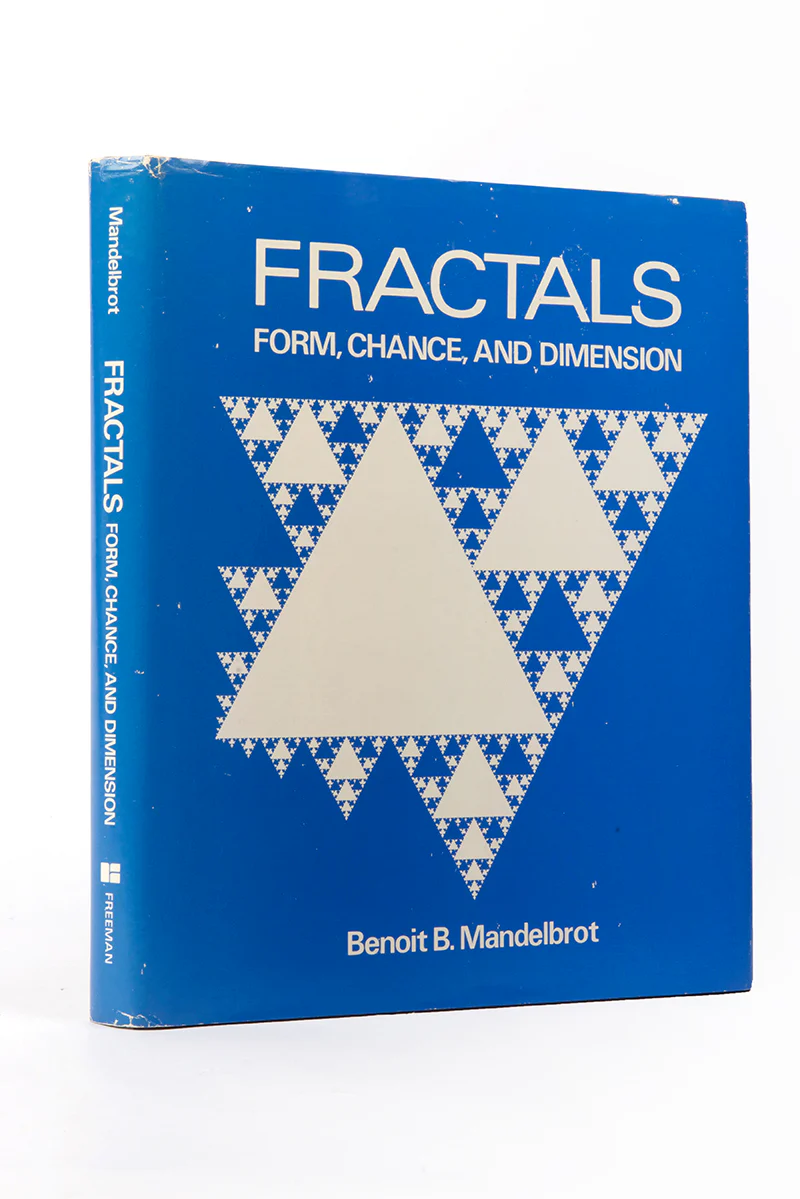
First English language edition, first printing, of the book that introduced Mandelbrot's revolutionary fractal mathematics to the world. Originally published in French in 1975 under the title Les Objects Fractals: Forme, Hasard et Dimension; this edition is based on the text of the revised and expanded second French edition. A lovely copy.Fractals reflect the repetitive geometric properties of certain aspects of nature, such as the nestled repeating patterns of Romanesco broccoli. Mandelbrot began investigating them at the IBM Research Center in the 1970s, where 'his typical mode of operation was to apply fairly straightforward mathematics (typically the theory of random processes) to areas that had barely seen the light of serious mathematics before' (Wolfram, 'The Father of Fractals, The Wall Street Journal, November 22, 2012).
When a colleague suggested writing a book based on his disparate mathematical investigations, 'Mandelbrot ended up doing a great piece of science and identifying a much stronger and more fundamental idea - put simply, that there are some geometric shapes, which he called "fractals", that are equally rough at all scales. No matter how close you look, they never get simpler, much as the section of a rocky coastline you can see at your feet looks just as jagged as the stretch you can see from space. This insight for the core of his breakout 1975 book, Fractals. Before this book, Mandelbrot's work had been decidedly numerical, with simple graphs being about a visual as most of his papers got. But between his access to computer graphics at IBM and publishers with distinctly visual orientations, his book ended up filled with striking illustrations, with his theme presented in a highly geometric way. There was no book like it. It was a new paradigm, both in presentation and in the informal style of explanation it employed' (Wolfram).
First English language edition, first printing; 4to; illustrations throughout the text, contents fresh; original dark blue cloth blocked in silver, patterned endpapers, a very good copy in the lightly rubbed jacket with a short closed tear to the lower panel; 365pp.
$53,066.65
Fractals. Form, Chance and Dimension.—
$53,066.65
Product Information
Product Information
Shipping & Returns
Shipping & Returns
Description
there was no book like it
First English language edition, first printing, of the book that introduced Mandelbrot's revolutionary fractal mathematics to the world. Originally published in French in 1975 under the title Les Objects Fractals: Forme, Hasard et Dimension; this edition is based on the text of the revised and expanded second French edition. A lovely copy.Fractals reflect the repetitive geometric properties of certain aspects of nature, such as the nestled repeating patterns of Romanesco broccoli. Mandelbrot began investigating them at the IBM Research Center in the 1970s, where 'his typical mode of operation was to apply fairly straightforward mathematics (typically the theory of random processes) to areas that had barely seen the light of serious mathematics before' (Wolfram, 'The Father of Fractals, The Wall Street Journal, November 22, 2012).
When a colleague suggested writing a book based on his disparate mathematical investigations, 'Mandelbrot ended up doing a great piece of science and identifying a much stronger and more fundamental idea - put simply, that there are some geometric shapes, which he called "fractals", that are equally rough at all scales. No matter how close you look, they never get simpler, much as the section of a rocky coastline you can see at your feet looks just as jagged as the stretch you can see from space. This insight for the core of his breakout 1975 book, Fractals. Before this book, Mandelbrot's work had been decidedly numerical, with simple graphs being about a visual as most of his papers got. But between his access to computer graphics at IBM and publishers with distinctly visual orientations, his book ended up filled with striking illustrations, with his theme presented in a highly geometric way. There was no book like it. It was a new paradigm, both in presentation and in the informal style of explanation it employed' (Wolfram).
First English language edition, first printing; 4to; illustrations throughout the text, contents fresh; original dark blue cloth blocked in silver, patterned endpapers, a very good copy in the lightly rubbed jacket with a short closed tear to the lower panel; 365pp.