🚚 Free Worldwide Shipping on All Orders!Shop Now
1 / 4
The Chronicle of the Discovery and Conquest of Guinea.
Unknown until a manuscript was discovered in 1839, Azurara's Crónica dos feitos da Guiné is the principal historical source for modern understanding of Prince Henry the Navigator and the Henrican age of Portuguese discoveries.
Gomes Eanes de Zurara (c. 1410 – c. 1474), sometimes spelled Eannes or Azurara, was a Portuguese chronicler of the European Age of Discovery, the most notable after Fernão Lopes.
Zurara adopted the career of letters in middle life. He probably entered the royal library as assistant to Fernão Lopes during the reign of King Edward of Portugal (1433–1438), and he had sole charge of it in 1452. His Chronicle of the Siege and Capture of Ceuta, a supplement (third part) to Lopes's Chronicle of King John I, dates from 1449 to 1450, and three years later he completed the first draft of the Chronicle of the Discovery and Conquest of Guinea, our authority for the early Portuguese voyages of discovery down the African coast and in the ocean, more especially for those undertaken under the auspices of Prince Henry the Navigator. It contains some account of the life work of that prince, and it has biographical as well as geographical interest.
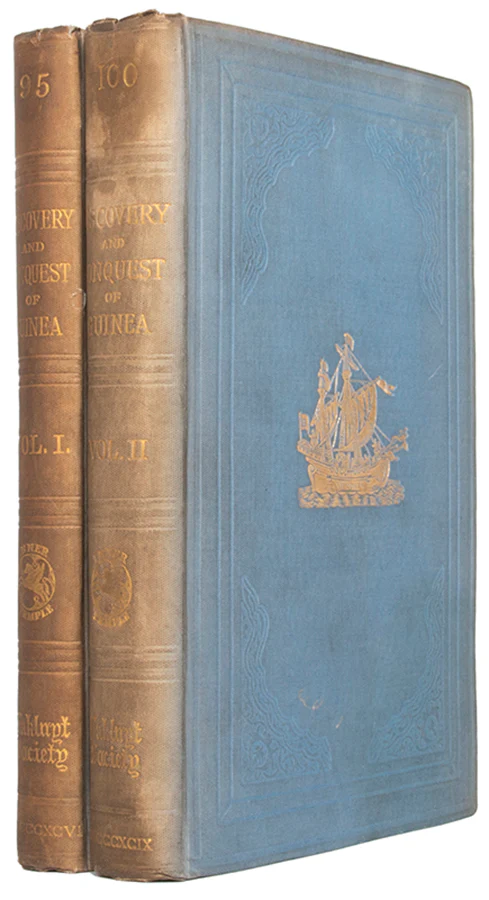
First English edition, Hakluyt Society First Series, XCV, C; 2 vols, 8vos (22.5 x 15 cm); 9 maps, 1 plate, ex libris Inner Temple Library with bookplates and stamps, withdrawn stamp to titles, a small waterstain to upper inner margin not affecting text; original publisher's gilt blue cloth, slight dampstaining to boards, spines darkened, otherwise a very good set; xii, lxvii, 127, 16; [16], cl, (129)-362, 30pp.
Gomes Eanes de Zurara (c. 1410 – c. 1474), sometimes spelled Eannes or Azurara, was a Portuguese chronicler of the European Age of Discovery, the most notable after Fernão Lopes.
Zurara adopted the career of letters in middle life. He probably entered the royal library as assistant to Fernão Lopes during the reign of King Edward of Portugal (1433–1438), and he had sole charge of it in 1452. His Chronicle of the Siege and Capture of Ceuta, a supplement (third part) to Lopes's Chronicle of King John I, dates from 1449 to 1450, and three years later he completed the first draft of the Chronicle of the Discovery and Conquest of Guinea, our authority for the early Portuguese voyages of discovery down the African coast and in the ocean, more especially for those undertaken under the auspices of Prince Henry the Navigator. It contains some account of the life work of that prince, and it has biographical as well as geographical interest.
First English edition, Hakluyt Society First Series, XCV, C; 2 vols, 8vos (22.5 x 15 cm); 9 maps, 1 plate, ex libris Inner Temple Library with bookplates and stamps, withdrawn stamp to titles, a small waterstain to upper inner margin not affecting text; original publisher's gilt blue cloth, slight dampstaining to boards, spines darkened, otherwise a very good set; xii, lxvii, 127, 16; [16], cl, (129)-362, 30pp.
$18,211.51
Original: $60,705.04
-70%The Chronicle of the Discovery and Conquest of Guinea.—
$60,705.04
$18,211.51Product Information
Product Information
Shipping & Returns
Shipping & Returns
Description
Unknown until a manuscript was discovered in 1839, Azurara's Crónica dos feitos da Guiné is the principal historical source for modern understanding of Prince Henry the Navigator and the Henrican age of Portuguese discoveries.
Gomes Eanes de Zurara (c. 1410 – c. 1474), sometimes spelled Eannes or Azurara, was a Portuguese chronicler of the European Age of Discovery, the most notable after Fernão Lopes.
Zurara adopted the career of letters in middle life. He probably entered the royal library as assistant to Fernão Lopes during the reign of King Edward of Portugal (1433–1438), and he had sole charge of it in 1452. His Chronicle of the Siege and Capture of Ceuta, a supplement (third part) to Lopes's Chronicle of King John I, dates from 1449 to 1450, and three years later he completed the first draft of the Chronicle of the Discovery and Conquest of Guinea, our authority for the early Portuguese voyages of discovery down the African coast and in the ocean, more especially for those undertaken under the auspices of Prince Henry the Navigator. It contains some account of the life work of that prince, and it has biographical as well as geographical interest.
First English edition, Hakluyt Society First Series, XCV, C; 2 vols, 8vos (22.5 x 15 cm); 9 maps, 1 plate, ex libris Inner Temple Library with bookplates and stamps, withdrawn stamp to titles, a small waterstain to upper inner margin not affecting text; original publisher's gilt blue cloth, slight dampstaining to boards, spines darkened, otherwise a very good set; xii, lxvii, 127, 16; [16], cl, (129)-362, 30pp.
Gomes Eanes de Zurara (c. 1410 – c. 1474), sometimes spelled Eannes or Azurara, was a Portuguese chronicler of the European Age of Discovery, the most notable after Fernão Lopes.
Zurara adopted the career of letters in middle life. He probably entered the royal library as assistant to Fernão Lopes during the reign of King Edward of Portugal (1433–1438), and he had sole charge of it in 1452. His Chronicle of the Siege and Capture of Ceuta, a supplement (third part) to Lopes's Chronicle of King John I, dates from 1449 to 1450, and three years later he completed the first draft of the Chronicle of the Discovery and Conquest of Guinea, our authority for the early Portuguese voyages of discovery down the African coast and in the ocean, more especially for those undertaken under the auspices of Prince Henry the Navigator. It contains some account of the life work of that prince, and it has biographical as well as geographical interest.
First English edition, Hakluyt Society First Series, XCV, C; 2 vols, 8vos (22.5 x 15 cm); 9 maps, 1 plate, ex libris Inner Temple Library with bookplates and stamps, withdrawn stamp to titles, a small waterstain to upper inner margin not affecting text; original publisher's gilt blue cloth, slight dampstaining to boards, spines darkened, otherwise a very good set; xii, lxvii, 127, 16; [16], cl, (129)-362, 30pp.