🚚 Free Worldwide Shipping on All Orders!Shop Now
1 / 3
Considerations on Negro Slavery.
A pro-slavery work produced in the midst of the uprisings in the Caribbean. Written for the benefit of the plantation owners, it conveys the common argument of the time, namely that the sugar plantations of the Caribbean must continue to operate profitably for the benefit of the islands.
Although seeing the need to 'abolish slavery judiciously and effectually', the tone is still one of viewing the islands as colonial assets that needs must provide a service to Britain in the form of profit. The belief in the 'unlikelihood of the negroes emerging into a free peasantry working for hire' is one of condescension that still seeks to keep the plantation owners in economic power.
Alexander McDonnell (1798-1835) was the Secretary of the Committee of West Indian Merchants and strongly advocated for the interests of slave-holders. Acting as the voice of West Indian plantation owners made him a wealthy man and allowed him the time and leisure to become a world renowned chess player in the age of amateurs.
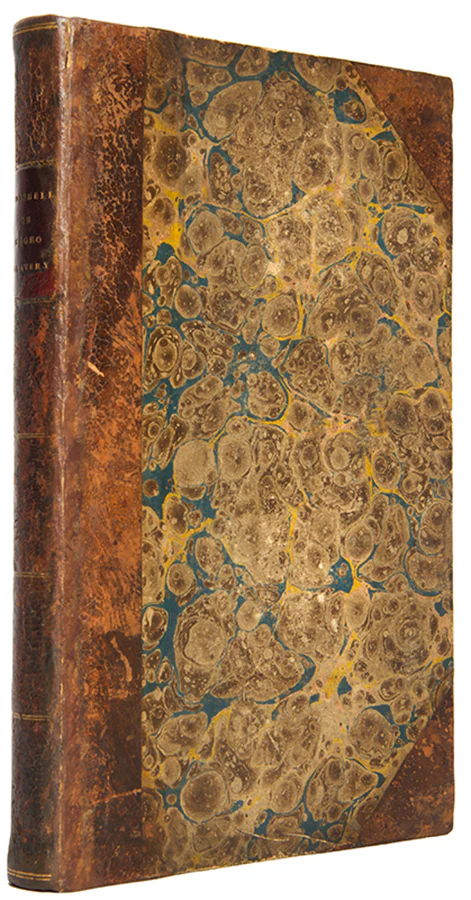
First edition; 8vo (21.5 x 14 cm); half mottled calf by Carrs of Glasgow, marbled boards, spine in 6 gilt-ruled compartments, contrasting gilt red morocco lettering-piece, all edges yellow, spine ends and joints expertly restored, light waterstain to rear endpapers, otherwise internally clean, a very good copy; xii, 338pp.
Sabin 43172.
Although seeing the need to 'abolish slavery judiciously and effectually', the tone is still one of viewing the islands as colonial assets that needs must provide a service to Britain in the form of profit. The belief in the 'unlikelihood of the negroes emerging into a free peasantry working for hire' is one of condescension that still seeks to keep the plantation owners in economic power.
Alexander McDonnell (1798-1835) was the Secretary of the Committee of West Indian Merchants and strongly advocated for the interests of slave-holders. Acting as the voice of West Indian plantation owners made him a wealthy man and allowed him the time and leisure to become a world renowned chess player in the age of amateurs.
First edition; 8vo (21.5 x 14 cm); half mottled calf by Carrs of Glasgow, marbled boards, spine in 6 gilt-ruled compartments, contrasting gilt red morocco lettering-piece, all edges yellow, spine ends and joints expertly restored, light waterstain to rear endpapers, otherwise internally clean, a very good copy; xii, 338pp.
Sabin 43172.
$1,138.12
Original: $3,793.73
-70%Considerations on Negro Slavery.—
$3,793.73
$1,138.12Product Information
Product Information
Shipping & Returns
Shipping & Returns
Description
A pro-slavery work produced in the midst of the uprisings in the Caribbean. Written for the benefit of the plantation owners, it conveys the common argument of the time, namely that the sugar plantations of the Caribbean must continue to operate profitably for the benefit of the islands.
Although seeing the need to 'abolish slavery judiciously and effectually', the tone is still one of viewing the islands as colonial assets that needs must provide a service to Britain in the form of profit. The belief in the 'unlikelihood of the negroes emerging into a free peasantry working for hire' is one of condescension that still seeks to keep the plantation owners in economic power.
Alexander McDonnell (1798-1835) was the Secretary of the Committee of West Indian Merchants and strongly advocated for the interests of slave-holders. Acting as the voice of West Indian plantation owners made him a wealthy man and allowed him the time and leisure to become a world renowned chess player in the age of amateurs.
First edition; 8vo (21.5 x 14 cm); half mottled calf by Carrs of Glasgow, marbled boards, spine in 6 gilt-ruled compartments, contrasting gilt red morocco lettering-piece, all edges yellow, spine ends and joints expertly restored, light waterstain to rear endpapers, otherwise internally clean, a very good copy; xii, 338pp.
Sabin 43172.
Although seeing the need to 'abolish slavery judiciously and effectually', the tone is still one of viewing the islands as colonial assets that needs must provide a service to Britain in the form of profit. The belief in the 'unlikelihood of the negroes emerging into a free peasantry working for hire' is one of condescension that still seeks to keep the plantation owners in economic power.
Alexander McDonnell (1798-1835) was the Secretary of the Committee of West Indian Merchants and strongly advocated for the interests of slave-holders. Acting as the voice of West Indian plantation owners made him a wealthy man and allowed him the time and leisure to become a world renowned chess player in the age of amateurs.
First edition; 8vo (21.5 x 14 cm); half mottled calf by Carrs of Glasgow, marbled boards, spine in 6 gilt-ruled compartments, contrasting gilt red morocco lettering-piece, all edges yellow, spine ends and joints expertly restored, light waterstain to rear endpapers, otherwise internally clean, a very good copy; xii, 338pp.
Sabin 43172.