🚚 Free Worldwide Shipping on All Orders!Shop Now
1 / 4
Television 1975-1976.
Mochizuki Masao studied at Tokyo College of Photography in the early 1960s, where his classmates included photographer Issei Suda and Motomura Kazuhiko, founder of Yugensha publishers; Motomura distributed this book. For the first ten years of his career, Mochizuki worked as a commercial and primarily street photographer in Tokyo. However, frustrated by the overtly subjective nature of this work, he began a more experimental working style that used shared cultural media to avoid such subjectivity.
In the mid-1970s, over two years, Mochizuki, who was interested in the '"life force" of television, the never-ending stream of images that defines our experience of the outside world,' took a series of photographs of his television screen using a complex analogue process, capturing both high and low culture, including pivotal mid-1970s television events such as the United States withdrawal from Saigon, the Apollo-Soyuz space mission, the Viking No.1 landing on Mars, the death of Mao Tse-Tung, the reopening of the Suez Canal, and Muhammad Ali vs Joe Frazier in Manila, together with local news and entertainment programming including a showing of Akira Kurosawa's The Seven Samurai (1954).
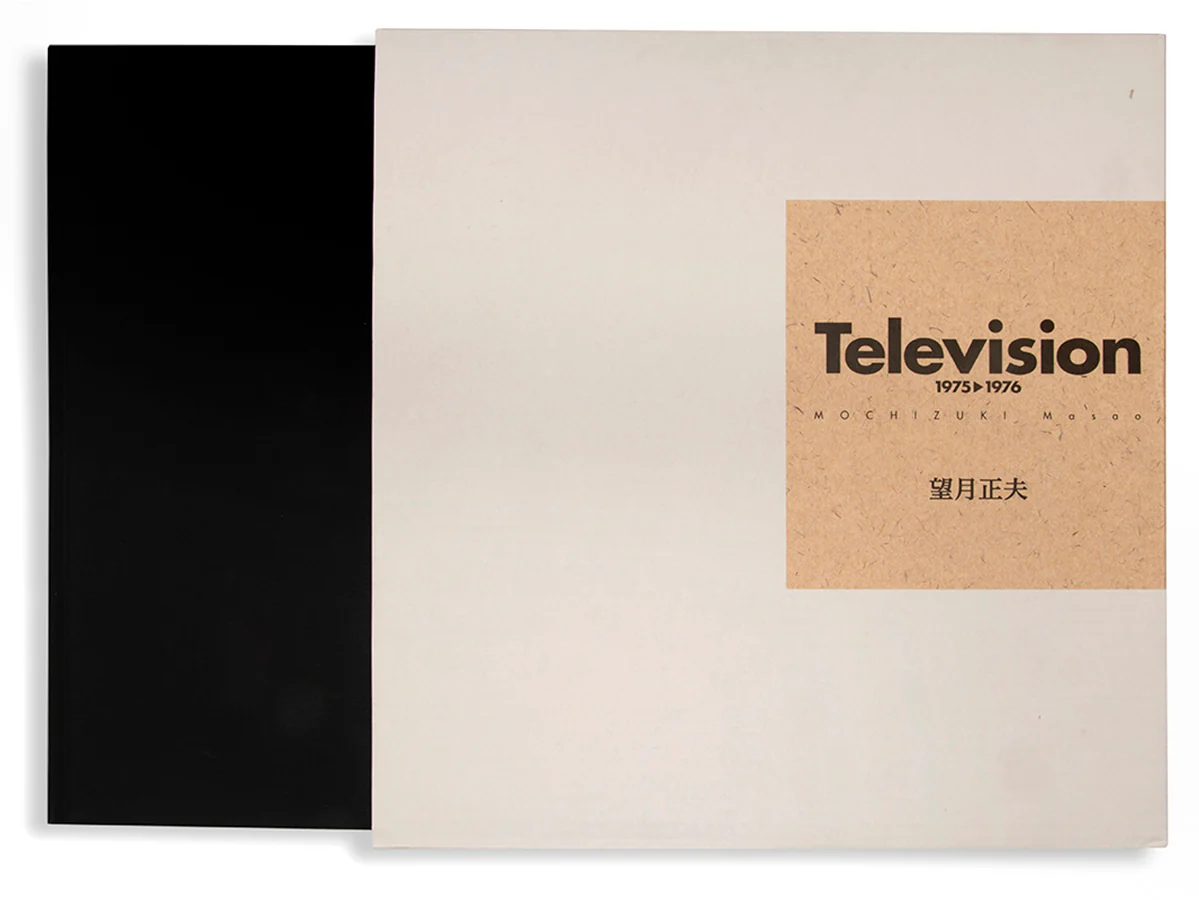
First edition; folio (365 x 365 mm, 14¼ x 14¼ in); black-and-white photographs printed in offset, text in Japanese and English by Ikui Eikoh, design by Daisuke Suzuki; black endpapers, black cloth-covered boards, spine and front lettered in blind, publisher's white card slipcase with brown and black printed label, black sandpaper strips on sides to aide removal, fine; [80]pp.
In the mid-1970s, over two years, Mochizuki, who was interested in the '"life force" of television, the never-ending stream of images that defines our experience of the outside world,' took a series of photographs of his television screen using a complex analogue process, capturing both high and low culture, including pivotal mid-1970s television events such as the United States withdrawal from Saigon, the Apollo-Soyuz space mission, the Viking No.1 landing on Mars, the death of Mao Tse-Tung, the reopening of the Suez Canal, and Muhammad Ali vs Joe Frazier in Manila, together with local news and entertainment programming including a showing of Akira Kurosawa's The Seven Samurai (1954).
First edition; folio (365 x 365 mm, 14¼ x 14¼ in); black-and-white photographs printed in offset, text in Japanese and English by Ikui Eikoh, design by Daisuke Suzuki; black endpapers, black cloth-covered boards, spine and front lettered in blind, publisher's white card slipcase with brown and black printed label, black sandpaper strips on sides to aide removal, fine; [80]pp.
$759.82
Television 1975-1976.—
$759.82
Product Information
Product Information
Shipping & Returns
Shipping & Returns
Description
Mochizuki Masao studied at Tokyo College of Photography in the early 1960s, where his classmates included photographer Issei Suda and Motomura Kazuhiko, founder of Yugensha publishers; Motomura distributed this book. For the first ten years of his career, Mochizuki worked as a commercial and primarily street photographer in Tokyo. However, frustrated by the overtly subjective nature of this work, he began a more experimental working style that used shared cultural media to avoid such subjectivity.
In the mid-1970s, over two years, Mochizuki, who was interested in the '"life force" of television, the never-ending stream of images that defines our experience of the outside world,' took a series of photographs of his television screen using a complex analogue process, capturing both high and low culture, including pivotal mid-1970s television events such as the United States withdrawal from Saigon, the Apollo-Soyuz space mission, the Viking No.1 landing on Mars, the death of Mao Tse-Tung, the reopening of the Suez Canal, and Muhammad Ali vs Joe Frazier in Manila, together with local news and entertainment programming including a showing of Akira Kurosawa's The Seven Samurai (1954).
First edition; folio (365 x 365 mm, 14¼ x 14¼ in); black-and-white photographs printed in offset, text in Japanese and English by Ikui Eikoh, design by Daisuke Suzuki; black endpapers, black cloth-covered boards, spine and front lettered in blind, publisher's white card slipcase with brown and black printed label, black sandpaper strips on sides to aide removal, fine; [80]pp.
In the mid-1970s, over two years, Mochizuki, who was interested in the '"life force" of television, the never-ending stream of images that defines our experience of the outside world,' took a series of photographs of his television screen using a complex analogue process, capturing both high and low culture, including pivotal mid-1970s television events such as the United States withdrawal from Saigon, the Apollo-Soyuz space mission, the Viking No.1 landing on Mars, the death of Mao Tse-Tung, the reopening of the Suez Canal, and Muhammad Ali vs Joe Frazier in Manila, together with local news and entertainment programming including a showing of Akira Kurosawa's The Seven Samurai (1954).
First edition; folio (365 x 365 mm, 14¼ x 14¼ in); black-and-white photographs printed in offset, text in Japanese and English by Ikui Eikoh, design by Daisuke Suzuki; black endpapers, black cloth-covered boards, spine and front lettered in blind, publisher's white card slipcase with brown and black printed label, black sandpaper strips on sides to aide removal, fine; [80]pp.