🚚 Free Worldwide Shipping on All Orders!Shop Now
HomeStore
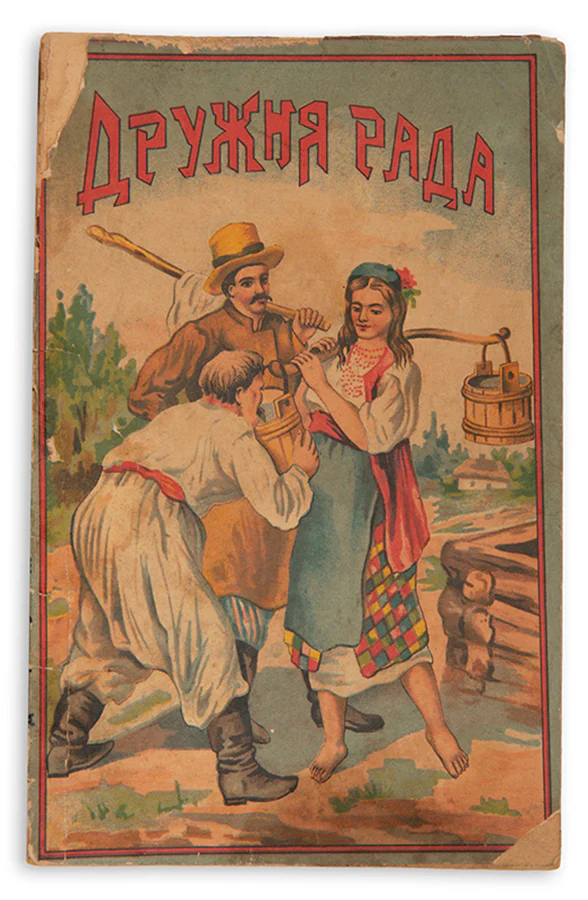
Druzhnia Rada abo 'Veseli zharty – smikhu varti'. Zbirnyk opovidan', kazok, virshiv ta baiok [Friendly Council or 'Funny Jokes - Worth Laughing'. Collection of Stories, Folk Tales, Verses and Fables].
1 / 4
Druzhnia Rada abo 'Veseli zharty – smikhu varti'. Zbirnyk opovidan', kazok, virshiv ta baiok [Friendly Council or 'Funny Jokes - Worth Laughing'. Collection of Stories, Folk Tales, Verses and Fables].
An extremely rare collection of Ukrainian prose and poetry compiled by the writer Klym Polishchuk (1891-1937). It includes little known works by K. Zhurlyvyi, T. Kobzarenko, P. Koval'chuk, M. Kovalenko, M. Bandurist and V. Perebyinis.
Polishchuk made his debut in 1909 with his first prose publication in the Lviv magazine 'Dzvinok'. In 1912, he came back to Zhytomyr, traveled across Volhynia and recorded folklore. Soon after 1914, he headed the first Ukrainian bookstore in St. Petersburg that was later transformed into the Drukar publishing house. In the early post-revolutionary period, he lived in Kyiv, edited local periodicals and took part in literary events. Together with the UNR Army, he emigrated to Galicia in 1920, and the Lviv period became the most prolific for his publications. However, Polishchuk returned to Eastern Ukraine in 1924 and collaborated with the State Publishing House of Ukraine, in 1929, he brought them his last manuscript 'Polissya Noises' but it was never published. He was arrested the same year under charges of 'bourgeois nationalism' and sent to the Solovki camp along with other hundreds of other members of the Ukrainian intelligentsia such as Les Kurbas and Mykola Kulish. They were all shot in Sandarmokh in Karelia in 1937 as part of what is now called the 'Executed Renaissance'.
First edition, 8vo (19.5 x 13 cm); 47pp., soiling to lower margin of preliminary leaves; in the original illustrated wrappers, water stains to inside of covers, spine glued, some loss to spine and upper cover, tears, otherwise a good copy.
Polishchuk made his debut in 1909 with his first prose publication in the Lviv magazine 'Dzvinok'. In 1912, he came back to Zhytomyr, traveled across Volhynia and recorded folklore. Soon after 1914, he headed the first Ukrainian bookstore in St. Petersburg that was later transformed into the Drukar publishing house. In the early post-revolutionary period, he lived in Kyiv, edited local periodicals and took part in literary events. Together with the UNR Army, he emigrated to Galicia in 1920, and the Lviv period became the most prolific for his publications. However, Polishchuk returned to Eastern Ukraine in 1924 and collaborated with the State Publishing House of Ukraine, in 1929, he brought them his last manuscript 'Polissya Noises' but it was never published. He was arrested the same year under charges of 'bourgeois nationalism' and sent to the Solovki camp along with other hundreds of other members of the Ukrainian intelligentsia such as Les Kurbas and Mykola Kulish. They were all shot in Sandarmokh in Karelia in 1937 as part of what is now called the 'Executed Renaissance'.
First edition, 8vo (19.5 x 13 cm); 47pp., soiling to lower margin of preliminary leaves; in the original illustrated wrappers, water stains to inside of covers, spine glued, some loss to spine and upper cover, tears, otherwise a good copy.
$804.04
Original: $2,680.13
-70%Druzhnia Rada abo 'Veseli zharty – smikhu varti'. Zbirnyk opovidan', kazok, virshiv ta baiok [Friendly Council or 'Funny Jokes - Worth Laughing'. Collection of Stories, Folk Tales, Verses and Fables].—
$2,680.13
$804.04Product Information
Product Information
Shipping & Returns
Shipping & Returns
Description
An extremely rare collection of Ukrainian prose and poetry compiled by the writer Klym Polishchuk (1891-1937). It includes little known works by K. Zhurlyvyi, T. Kobzarenko, P. Koval'chuk, M. Kovalenko, M. Bandurist and V. Perebyinis.
Polishchuk made his debut in 1909 with his first prose publication in the Lviv magazine 'Dzvinok'. In 1912, he came back to Zhytomyr, traveled across Volhynia and recorded folklore. Soon after 1914, he headed the first Ukrainian bookstore in St. Petersburg that was later transformed into the Drukar publishing house. In the early post-revolutionary period, he lived in Kyiv, edited local periodicals and took part in literary events. Together with the UNR Army, he emigrated to Galicia in 1920, and the Lviv period became the most prolific for his publications. However, Polishchuk returned to Eastern Ukraine in 1924 and collaborated with the State Publishing House of Ukraine, in 1929, he brought them his last manuscript 'Polissya Noises' but it was never published. He was arrested the same year under charges of 'bourgeois nationalism' and sent to the Solovki camp along with other hundreds of other members of the Ukrainian intelligentsia such as Les Kurbas and Mykola Kulish. They were all shot in Sandarmokh in Karelia in 1937 as part of what is now called the 'Executed Renaissance'.
First edition, 8vo (19.5 x 13 cm); 47pp., soiling to lower margin of preliminary leaves; in the original illustrated wrappers, water stains to inside of covers, spine glued, some loss to spine and upper cover, tears, otherwise a good copy.
Polishchuk made his debut in 1909 with his first prose publication in the Lviv magazine 'Dzvinok'. In 1912, he came back to Zhytomyr, traveled across Volhynia and recorded folklore. Soon after 1914, he headed the first Ukrainian bookstore in St. Petersburg that was later transformed into the Drukar publishing house. In the early post-revolutionary period, he lived in Kyiv, edited local periodicals and took part in literary events. Together with the UNR Army, he emigrated to Galicia in 1920, and the Lviv period became the most prolific for his publications. However, Polishchuk returned to Eastern Ukraine in 1924 and collaborated with the State Publishing House of Ukraine, in 1929, he brought them his last manuscript 'Polissya Noises' but it was never published. He was arrested the same year under charges of 'bourgeois nationalism' and sent to the Solovki camp along with other hundreds of other members of the Ukrainian intelligentsia such as Les Kurbas and Mykola Kulish. They were all shot in Sandarmokh in Karelia in 1937 as part of what is now called the 'Executed Renaissance'.
First edition, 8vo (19.5 x 13 cm); 47pp., soiling to lower margin of preliminary leaves; in the original illustrated wrappers, water stains to inside of covers, spine glued, some loss to spine and upper cover, tears, otherwise a good copy.